A successful heat pump installation doesn’t end when the system is commissioned. The handover process plays a critical role in ensuring homeowners understand how to operate their new heating system effectively. Hamid Salimi, Residential Product Manager at Daikin, explores why installers and manufacturers must work together to improve the customer handover experience, build confidence in the technology and ensure homeowners can get the very best from their heat pump.
The latest increase to the Boiler Upgrade Scheme (BUS) grants, up to £9,000 for homes currently heated by oil or LPG, is a significant moment for professional heating and plumbing installers as well as manufacturers. It substantially lowers the financial barrier to adoption for the end-user and signals a clear, unwavering direction of travel from the government: heat pumps are central to the UK’s decarbonisation of home heating.
However, with this larger target market comes a more pressing, practical challenge for the workforce on the ground. As we transition from early adopters to the mass market, we are encountering consumers whose intuitive habits are exactly the wrong approach for a heat pump, creating a mismatch between expectation and reality where dissatisfaction breeds.
Root cause
Recent research has highlighted an important consideration regarding grid impact and efficiency: heat pump performance is influenced by how systems are used in day-to-day operation. This underlines the need for installers and manufacturers to work more closely with customers, providing clear guidance and ongoing support to help them get the best from their systems. Improving understanding and addressing common misconceptions will be key to enhancing customer satisfaction and strengthening confidence in heat pump technology.
When a homeowner is dissatisfied with their heat pump it is often due to a breakdown of support at the point of handover, and in the crucial weeks and months that follow the initial installation. A brief walkthrough on the day of installation is rarely sufficient, as homeowners arrive with expectations shaped by a lifetime of gas boiler use: turn it up, get heat quickly, and turn it off when you leave.
Heat pumps are engineered to maintain a steady, low-temperature environment rather than deliver rapid heat from a cold start. When occupants override settings, increase flow temperatures, or switch the system completely off when they go out (typical behaviours deeply learned from traditional gas boiler usage), system efficiency drops significantly.
Homeowners who do not understand how to operate their system correctly will experience higher-than-expected energy bills, leading to disappointment and frustration. Negative reviews and social media complaints follow, eroding public confidence in heat pump technology at precisely the moment when the industry needs to be building it.
Avoidable callbacks and aftercare queries also place unnecessary strain on installer and manufacturer support teams. In these scenarios, the technology has not failed; the homeowner simply has not been told how to use it properly.
Closing the handover gap
The solution is not complicated, but it does require commitment from both sides of the supply chain. Installers and manufacturers need to work together to deliver a solid handover process and a joined-up aftercare experience, one that gives homeowners the knowledge and confidence to get the best from their investment from day one.
Manufacturers have a major role to play in making this easier by providing clear, accessible homeowner guides, digital support resources, and well-trained technical teams that installers can lean on to contribute to a more confident handover.
Structured installer programmes like Daikin’s Sustainable Home Network go further, providing hands-on commissioning support, ongoing technical backup, and a clear development pathway from newcomer through to expert. When installers feel confident and well-supported, homeowners benefit directly.
For installers, the handover conversation needs to go beyond the basics of switching the system on. Key areas to cover include how heat pumps differ from gas boilers in operation, how to read and understand controls, how weather compensation works, and how homeowners can take advantage of time-of-use energy tariffs to reduce running costs. Where homes include EV charging, battery storage or rooftop solar, installers should also flag how these can be integrated for a smarter, lower-cost energy setup.
Technology enables ongoing support to be far more accessible and practical for the installer. Platforms such as Daikin’s Stand By Me connect the homeowner, installer, and manufacturer from the moment a system is commissioned, providing a single point of access for warranty, maintenance reminders, and service records.
Connected cloud services already allow installers to monitor systems remotely, receive automatic alerts, and adjust settings without returning to site. This isn’t a future ambition; it’s available now and is successfully reducing callbacks and improving homeowner satisfaction among those who use it.
Shared responsibility
The increasing BUS grant is an invitation to reach new customers, to grow the market, and to demonstrate that heat pump technology delivers when it is properly supported. That invitation comes with a responsibility though, to ensure every homeowner who makes the switch has the understanding and aftercare they need to have a genuinely positive experience.
Manufacturers and installers who rise to that challenge will benefit directly. Satisfied homeowners generate referrals. Fewer avoidable callbacks mean leaner operations, and a growing reputation for quality handovers differentiates businesses in an increasingly competitive market. Now it is time for the industry to ensure that every homeowner who chooses a heat pump is set up to succeed.
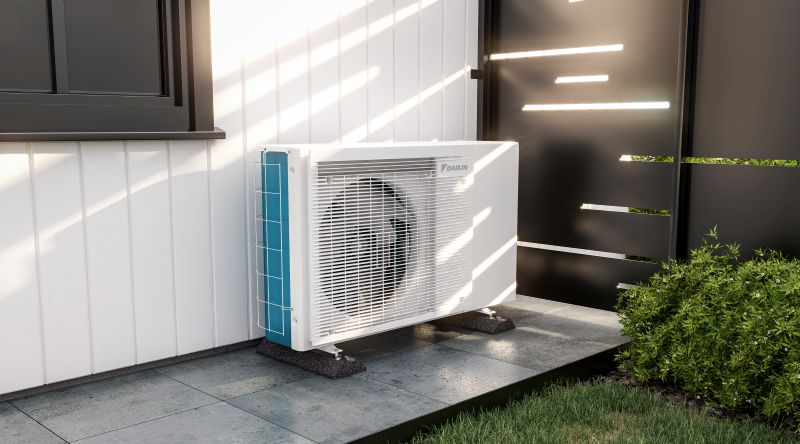
Image: Daikin