

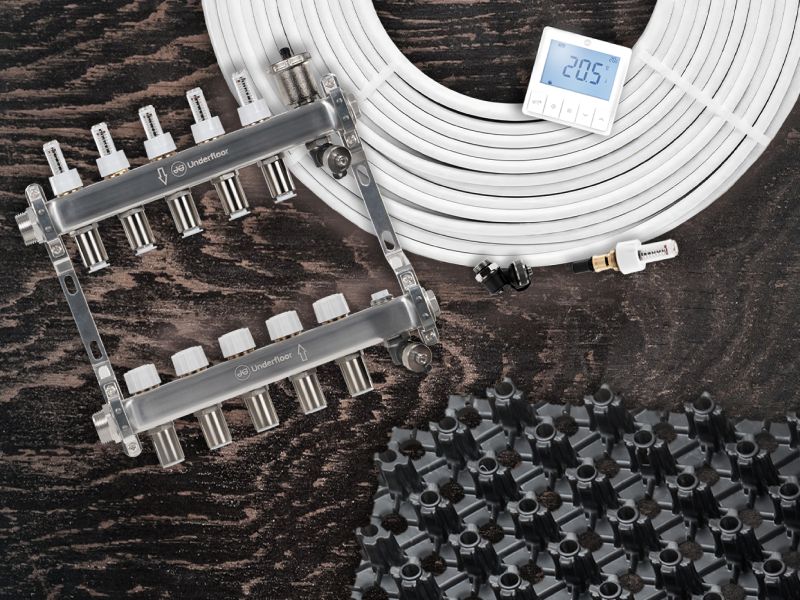
Sam White, Technical Sales Engineer, at RWC, explains the importance of manifolds and how installers can use them to maximise the potential of UFH systems.
Whether it’s down to shifting homeowner preferences, an increased focus on sustainability, or evolutions in heating technology, home heating is undergoing a revolution.
In recent years, underfloor heating has secured its place as one of the preferred choices amongst homeowners and housebuilders – and many installers have upskilled to meet rising demand for the installation of these systems. This growth shows no signs of slowing, with UFH now being widely specified across new build developments, and a firm favourite among homeowners undertaking home renovations.
To get the most of our underfloor heating systems and ensure they are fit for purpose for decades to come, manifolds play a critical role. Despite being a pivotal component, manifolds can be overlooked during the design and specification process. However, they can make all the difference when it comes to unlocking performance.
What, why, where
Wet underfloor heating systems are the most widely used in homes across the UK, largely due to their ability to work with a broad range of heat sources, be adaptable to projects of different shapes and sizes, and support straightforward installation.
Manifolds sit behind this functionality, acting as the vital control network that connects the heat source and the underfloor pipework that spans every zone. But they do more than circulate water around the system. They ensure correct distribution to every zone and maintain optimum temperatures to maximise system efficiency. It’s this function that also puts control into the hands of users, allowing them to select different temperatures in different zones, with the manifold making it possible.
To achieve the best results on every underfloor heating system, manifolds must be optimally positioned – which is typically central to the heating zones. As well as helping to keep pipe lengths to a minimum for each zone, a central location underpins system efficiency by minimising heat loss between the source and the network of pipes.
The location will also support future maintenance of the system. With pipes buried beneath the floor, their longevity is essential, with all other maintenance – including annual services – being carried out via the manifold.
Space considerations
When it comes to choosing the right manifold for the job, installers have to consider a broad range of factors – from how they operate through to what space they’ll occupy once up and running.
For most homeowners, space is essential, as it gives them more interior design freedom and greater flexibility with furniture choices. Maximised space is therefore just one of the factors that have given rise to underfloor heating in recent years, providing a viable way to move away from traditional radiator systems while effectively freeing up wall space and allowing rooms to offer greater functionality. With that in mind, choosing an UFH manifold – which must remain accessible and occupy a central location – that takes up as little room as possible is essential.
Consistent performance
The new Euroconus underfloor heating manifold from JG Underfloor provides a reliable option for installers.
Value-engineered to be more cost-efficient while maintaining the same high-quality as the JG Speedfit push-fit solutions, the Euroconus manifold is a mechanically connected solution for budget-focused projects that require reliable, consistent performance. Based on the same technology as previous manifolds, it is proven to deliver on domestic UFH installations, providing improved performance, flow adjustment, reliability and functionality that modern underfloor heating systems demand.
When used with the Euroconus adaptor, the manifold can also be paired with the new JG 16mm PERT pipe, which makes life easier for installers when fitting or maintaining the manifold.
Image: RWC