
Richard Braid, Managing Director at Cistermiser, explains why washroom retrofits are one of the most straightforward, cost-effective jobs an installer can offer a commercial client.
Water isn’t something businesses can take for granted anymore and the numbers back that up. Defra’s White Paper, A New Vision for Water, projects a daily shortfall of five billion litres across England by 2055, driven by a growing population, a changing climate and infrastructure that’s often decades old. Defra has also set targets to cut per capita consumption from 136.5 litres a day to 122 litres by 2038 and 110 litres by 2050, alongside a 15% cut in business water use by 2050.
The targets and changes happening now will shape what clients need to specify, and washrooms are often where the biggest, easiest wins are found.
Continuous flow
Thames Water data shows around 25-30% of water delivered to non-domestic properties is classed as continuous flow (one litre per hour or more, running for 14 days straight). This could be internal wastage, a leak, or genuine usage.
Two of the biggest contributors to continuous flow in businesses are likely leaky-loos and uncontrolled urinals. These are completely avoidable running costs that can be designed out of washrooms.
Improving urinals
Uncontrolled urinals are a big culprit when it comes to water waste. A standard auto-flush cistern cycling three times an hour (whether it’s needed or not) can use around 197,000 litres a year. But there are simple fixes.
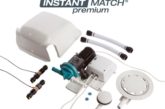
A motion sensor-controlled system detects when someone is near and triggers a flush only after use. Cistermiser’s Direct Flush, for example, fits directly onto the mains supply and removes the need for an auto-flush cistern. It reduces water consumption to around 15,000 litres a year, saving over £700 annually and roughly 0.06 tonnes of CO2, just by cutting out the flushes nobody needed.
Where the urinal is cistern-fed rather than mains-fed, the fix is just as straightforward. Cistermiser’s Infrared Control Valve uses a sensor to manage the flow of water to a cistern, only activating the solenoid valve that controls water when it detects occupancy, instead of topping up on a timer regardless of footfall. Again, it reduces water use by 80%, saves around £700 a year and cuts 0.06 tonnes of carbon.
Toilet upgrades
Toilet leaks can be harder to spot than water waste from urinals because they often show up as a slow trickle down the back of the pan rather than an obvious fault. According to the Waterwise UK Water Efficiency Strategy to 2030, between 5-8% of toilets across the UK are leaking, wasting around 400 million litres a day. One cause of a leaky loo is the traditional drop-valve system where the seal sits below the waterline, collecting scale and debris which causes degradation over time.
A flush valve with no seal below the waterline, like the Easyflush Evo, takes that problem out of the equation entirely. It is a sensor activated dual flush valve that won’t degrade and won’t leak, saving around 146,000 litres of water a year.
Direct flushing goes one step further by removing the cistern altogether and using mains pressure for a controlled flush instead. It means there is no standing water left to degrade a seal in the first place. Cistermiser’s Easyflush Direct works this way, and can save customers almost £600 a year with payback in 11 months.
Taps
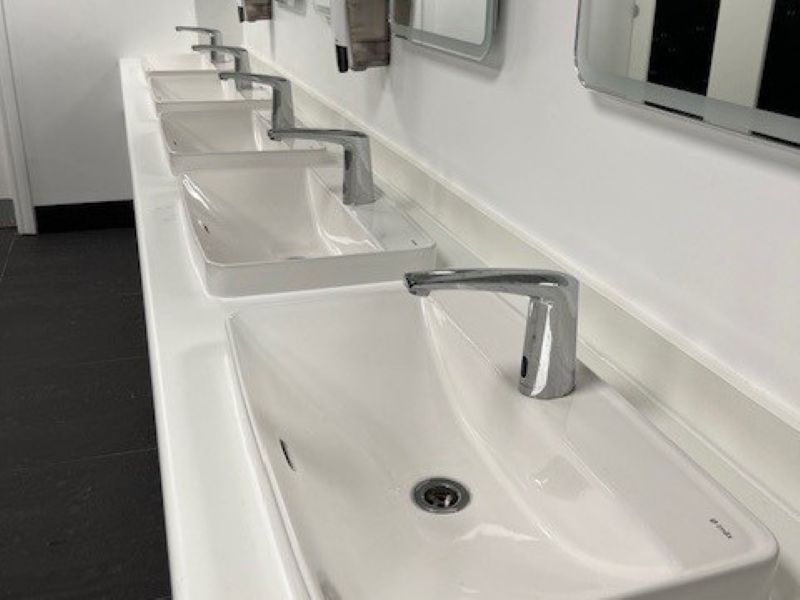
A dripping tap might not seem like much, but it can waste up to 5,500 litres a year. In washrooms, traditional taps can simply be left running, wasting even more water. Sensor taps only run when someone’s there. An infrared sensor detects hands placed in front of the faucet, sending a signal to open a solenoid valve to activate water. Cistermiser’s Vecta+ range also adds a 60-second safety shut-off, so a fault doesn’t turn into a flooded washroom. Using just one sensor tap can save clients over £600 a year.
The opportunity for installers
A straightforward washroom audit can reveal many issues: uncontrolled cisterns, leaking loos, taps with no sensor or flow restriction. Smart meter data helps where it’s available, but a lot of the waste in a typical light commercial washroom is obvious the moment you’re standing in front of it.
That’s where the opportunity sits for installers. Washroom retrofits tick every box: minimal disruption, fast payback and a clear reduction in both cost and carbon.
Image: Cistermiser