
A new whitepaper is urging the government to integrate hot water decarbonisation into its long-term housing and net-zero strategies, warning that hot water will soon become the dominant domestic energy load.
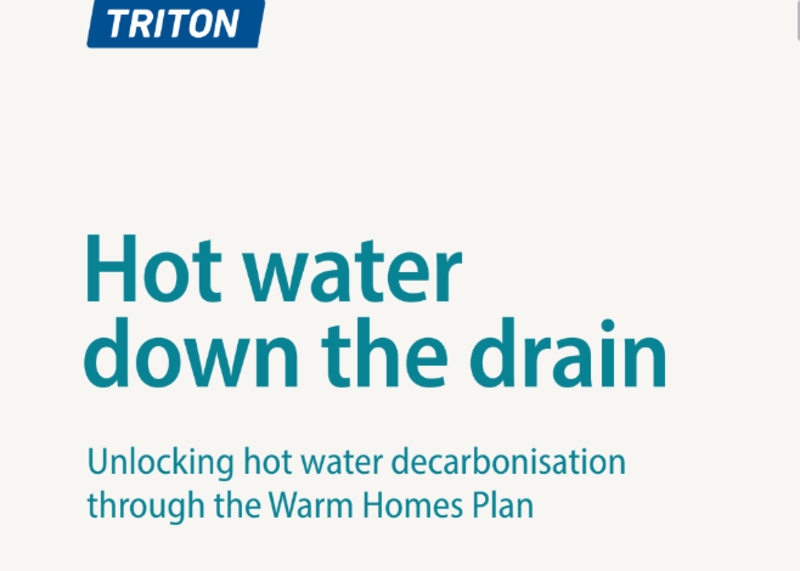
“Hot Water Down the Drain: Unlocking Hot Water Decarbonisation Through the Warm Homes Plan”, published by Triton Showers in response to the recently launched roadmap, reveals that hot water use, particularly showering, is a significant but overlooked opportunity to cut household energy consumption, carbon emissions and water use.
The report calls on the government to include instantaneous electric showers (IES) and a new category of high-efficiency models (IES-HE) designed to connect to waste water heat recovery systems (WWHRS) within major retrofit and energy efficiency funding schemes, namely the Warm Homes: Social Housing Fund (WH:SHF) and Warm Homes: Local Grant (WH:LG).
Paul Ravnbo-West, Market Development Manager at Triton Showers, said: “The current policy landscape is heavily weighted towards space heating, but as that decarbonises, hot water will make up a significant share of household energy use. If this isn’t addressed in the Warm Homes Plan, we risk missing a major opportunity to cut emissions and help households manage rising utility costs.
“Even where the plan acknowledges that approximately two-thirds of building emissions come from space heating and hot water, the policy instruments that follow overwhelmingly target the former.”
The paper outlines five policy actions needed to unlock hot water decarbonisation:
1 Integrate hot water decarbonisation into the UK’s net-zero strategy.
2 Incentivise consumers and housebuilders to invest in efficient shower technologies to meet upcoming water-use limits.
3 Include IES and IES-HE systems in Warm Homes Plan funding schemes, enabling households to access the savings these products can produce.
4 Update EPC methodologies (RdSAP/SAP) to recognise efficient electric shower technologies connected to WWHRS, improving consumer guidance and upgrading pathways.
5 Remove green levies from electricity, which currently add 9.92% to the unit price, to support switching to low-carbon, electric-based systems.
Paul continued: “As we strive towards net zero, it’s essential that the role of hot water isn’t overlooked. Electric showers offer a simple, scalable and cost-effective solution to reduce emissions, water usage and household bills across the nation. If actioned, these recommendations can play a crucial role in both futureproofing our housing stock and providing tangible savings to households today.”
To download “Hot Water Down the Drain: Unlocking Hot Water Decarbonisation Through the Warm Homes Plan”, please click here.
Image: Triton