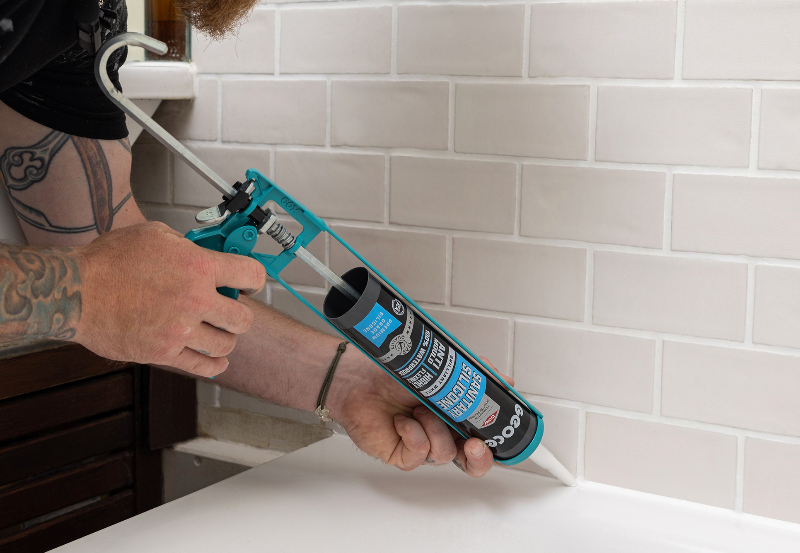
The sealant used on a kitchen or bathroom job can make a big impact on the final result. Here, Stuart Ruffles, Product Marketing Assistant at Geocel, looks at what professionals need to consider when choosing these products.
Kitchen and bathroom projects remain among the most popular renovations for homeowners. While only a small part of a bathroom or kitchen job, the choice of sealant has a big impact on the finished result.
Using an unsuitable or low-quality product can result in adhesion issues that are not only unsightly but lead to leaks and water damage if not addressed. It can also increase the likelihood of mould forming and allow bacteria to grow. All of this will have a significant impact on the customer’s satisfaction with the work overall, increase callbacks and even harm your reputation among potential new customers.
When it comes to the choice of sealants for plumbing jobs there is no one-size-fits-all solution and there is an array of possibilities.
 Selecting a sealant
The first way to narrow down the options is to only choose a product from a brand you know and trust. There is a reason why brands such as Geocel have been around for decades; generations of professionals have relied on their products every day. In the case of Geocel, customers also have the reassurance of ‘Powered by Dow’ on the packaging, with the knowledge that all these products benefit from premium grade silicone from Dow.
It is also important to choose a product that is right for the application. It is worth having a multi-purpose silicone sealant in your kit for general sealing tasks. One that is waterproof and has mould resistant properties is ideal. A good quality multi-purpose silicone sealant can be the ideal all-rounder, generally available in a variety of colours too. If opting for a general-purpose product, ensure that it still has the performance characteristics you need – waterproof, flexibility and anti-mould are three of the key ones.
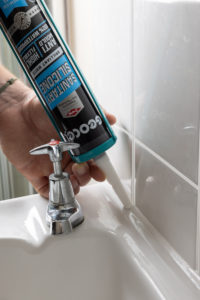
However, for kitchen and bathrooms, it is generally advisable to go with a sanitary silicone product as these will have been formulated specifically for the demands of the environment. Among the key features to look for is excellent unprimed adhesion to a range of non-porous surfaces, such as tiles, basins, sinks, toilets, showers and kitchen worktops.
High flexibility is also essential. Fixtures such as baths and shower screens will be subject to movement with use, as well as a degree of expansion and contraction with changes in temperature. Without flexibility the sealant will be susceptible to cracking and loss of adhesion.
Finally, any product used for this type of application should be anti-fungal and bacteria resistant to maintain the finished appearance and ensure the area remains as hygienic as possible.
Choosing the right silicone sealant can help ensure that a quality finish on a kitchen or bathroom job is maintained with no loss of adhesion, cracking, discolouration or mould.
Images: Geocel