

Engineers in HVAC and plumbing environments routinely face electrical hazards, sometimes without being fully aware of the risks. Whether installing control systems, renewable technology, boilers or even just working close to live circuits, a minor slip could lead to injury – explains Martindale Electric MD, Steve Dunning.
Each year, the Health and Safety Executive (HSE) records multiple electrical incidents among construction trades, including shocks, burns and life-threatening injuries – some of which prove fatal.
An effective safe isolation procedure helps prevent accidental contact with live parts, protecting both engineers and anyone else nearby, by ensuring all relevant circuits and equipment are fully de-energised before work begins. Failure to use correct procedures could result in a circuit inadvertently remaining live.
Safe Isolation – 5 key questions answered
Q. Why do I need Safe Isolation?
Safe isolation procedures are necessary to ensure workers on site are not exposed to danger when working on or near live electrical systems. Electrical Safety First, in association with other industry bodies, has produced a document that covers best practice for safe isolation. This includes guidance on proving isolated equipment or circuits are dead, using suitable test lamps and voltage detectors.
Q. What equipment isrequired for safe isolation?
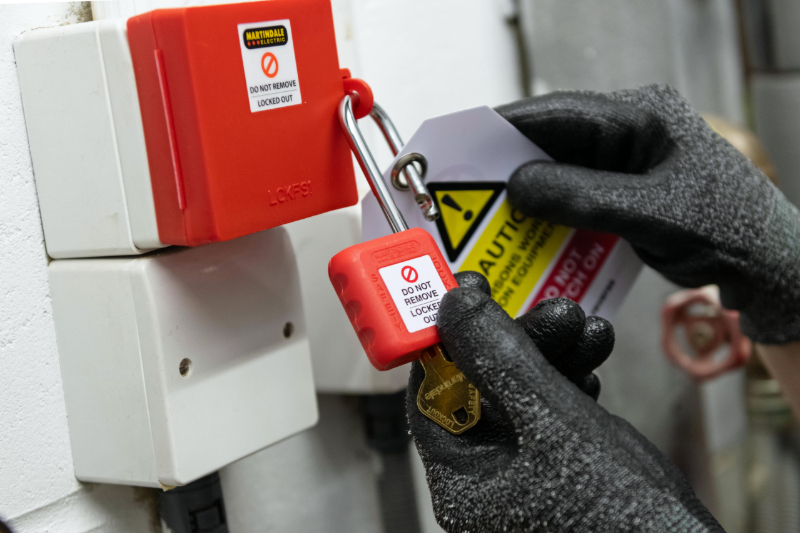
The point of isolation should be locked off using a unique key or combination, retained by the person carrying out the work or appointed person, and a caution notice attached to the point of isolation. Locking off the circuit is just one part of the procedure. Before carrying out any work, it’s essential to verify that the circuit is definitely dead. Circuits are frequently mislabelled, so there is no certainty that the correct circuit is locked off. To do this, you should use a dedicated voltage indicator and a proving unit.
Q. What is the correct equipment to use for proving dead?
A dedicated voltage indicator and a proving unit should be used when carrying out this procedure. Equipment must comply with BS EN61243. It is important to note that the voltage indicator must function without the need for a battery. If you are using a device that needs a battery in order to work and the battery is flat, you will not be able to prove if the circuit is dead or not.
Q. Can I use amultimeter or non-contact voltage detector to prove dead?
The use of multimeters or non-contact voltage detectors is not advisable. For multimeters, it is very easy to select the wrong range, plus they rely on battery power to function; thus, there is a high risk of making a false “dead” reading on a live circuit. Non-contact voltage detectors also require a battery in order to work and are often sensitive to other signals, such as static electricity. It’s also not possible to prove they are working correctly with a standard proving unit. Whilst these units can be used to detect live cables, they cannot reliably be used to prove dead.
Q. How can I find more information?
The above questions have only briefly touched on safe isolation procedures; further information can be found via:
– HSE’s publication Electricity at Work – Safe Working Practices
– Electrical Safety-First Best Practice Guide 2
– Safe Isolation Resources at Martindale Electric
Selecting the right equipment
There is a huge range of safe isolation equipment available, and selecting the right combination for your application can be daunting. As previously mentioned, a dedicated Voltage indicator meeting all the relevant standards, is essential. It is always recommended that the indicator be checked on a dedicated proving unit to ensure there is always an appropriate test voltage available. When it comes to lock out devices there are numerous options.
To simplify the choice, Martindale offer a range of complete kits designed for specific applications and industries. For example, the Martindale TB118A kit helps gas engineers working near electrical systems comply with Gas Safe Register Technical Bulletin 118 (Safe Isolation of gas appliances), the kit includes LOKKITGAS1 set of four key locking-off devices, the VI-13800 voltage indicator and the PD440S proving unit for safe, straightforward proving dead.
With guidelines well established and safe isolation kits readily available, implementing procedures is neither difficult nor expensive and has been proven to save lives and avoid injury. Quite simply, it’s essential for compliance with Electricity at Work Regulations for safe working when installing and maintaining electrical equipment and systems.
Image: Martindale Electric