
Selecting the right float valve can increase usable cold water storage capacity without increasing tank size. Keraflo’s Richard Braid explains how valve selection can help specifiers avoid tank modifications while preserving WRAS or KIWA approved configurations.
Choosing the correct float valve for a cold water storage tank can have a major impact on usable capacity, plant room layout and overall system efficiency. But in many commercial installations, the valve itself is still treated as a secondary consideration behind tank size and pipework design.
For specifiers working on projects where space is restricted or storage demands are increasing, valve selection can make the difference between needing a larger tank installation and achieving the required storage volume within the same footprint.
Keraflo’s K Type delayed action valve has been developed specifically to maximise tank capacity by allowing water levels to operate closer to the top of the cistern than equilibrium valves.
Using a standard 1m x 1m x 1m tank as an example, a typical 2” equilibrium valve provides an actual stored volume of around 504litres. A 2” Keraflo K Type valve allows approximately 805litres to be stored within the same tank. That represents an increase of more than 60% in usable storage capacity without increasing the physical tank size.
The difference comes from the operating characteristics of the valve itself. A conventional equilibrium valve requires a relatively low operating water line in order to function correctly. In the example shown, the top water level sits around 381mm below the centre line of the inlet. The Keraflo K Type valve operates differently, allowing the water level to rise to approximately 80mm below the centre line of the inlet while still maintaining stable valve operation. This can significantly increase the amount of usable stored water available within the cistern.
Unlike a conventional equilibrium valve, which continuously modulates as the water level changes, the K Type allows the tank to refill to a higher level before closing.
Storage volume
This approach can provide practical advantages for commercial plumbing systems. In plant rooms where available space is limited, increasing the effective storage volume of an existing tank footprint may remove the need for larger sectional tanks or additional storage capacity elsewhere within the system.
Reducing tank size requirements can also help lower associated installation costs including support steelwork, insulation and ancillary pipework, while improving access around equipment for ongoing maintenance.
In some installations, particularly on larger sectional tanks, the float valve may be installed within a raised float valve chamber rather than mounted directly through the side wall of the tank. In these applications, specifiers may attempt to achieve similar storage gains using a conventional equilibrium valve combined with aftermarket drop arm arrangements. However, modifying the valve assembly in this way can invalidate WRAS or KIWA approvals originally held by the product.
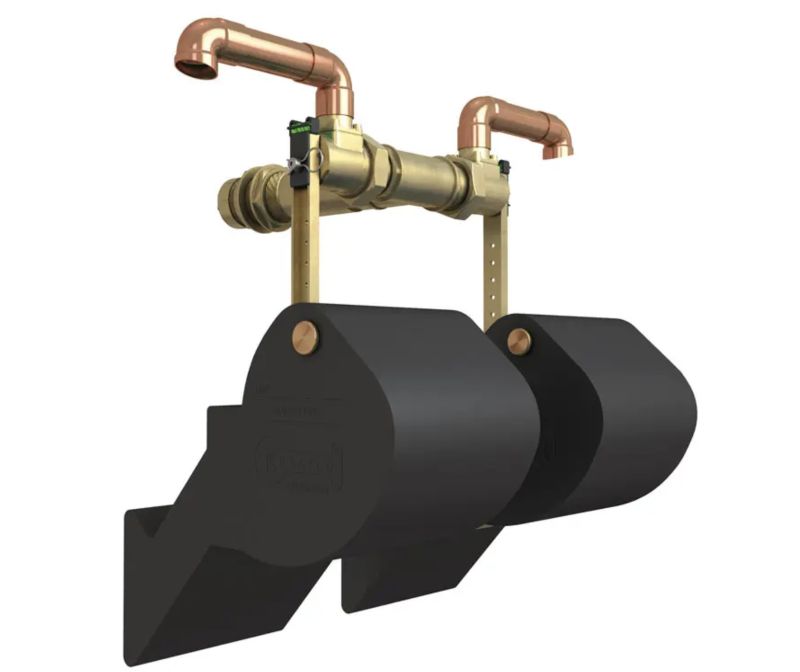
Keraflo developed the KAX valve specifically for raised float valve chamber applications. While the K Type is intended for standard side-mounted tank arrangements, the KAX has been designed to achieve the same high water level benefits in tanks where the float valve chamber sits above the main tank section.
The KAX also incorporates nominal delayed action operation while maintaining the approved valve configuration. This allows specifiers to increase usable storage capacity without relying on improvised modifications or non-approved valve arrangements.
System design
As with all cold water storage installations, correct system design remains essential. Tanks should comply with all relevant Water Supply (Water Fittings) Regulations and WRAS guidance, with appropriate screened overflows, servicing access and correctly sized pipework to support refill performance. Valve positioning and float arrangements should also be carefully considered during specification to ensure the intended operating water levels are achieved.
As commercial buildings continue to place greater demands on stored water systems, improving the efficiency of available tank space is becoming increasingly important. While tank dimensions remain a major consideration during design, the float valve itself can have a substantial effect on overall system performance and usable storage volume.
For many projects, selecting the correct valve arrangement can deliver the equivalent benefit of a significantly larger tank installation without increasing plant room requirements or introducing unnecessary system complexity. For projects where space, performance and compliance all matter, maximising tank capacity through valve selection is becoming an increasingly valuable design consideration.
To download the 2026 edition of Keraflo’s Essential Guide to Water Tank Management please click here.
Image: Keraflo