

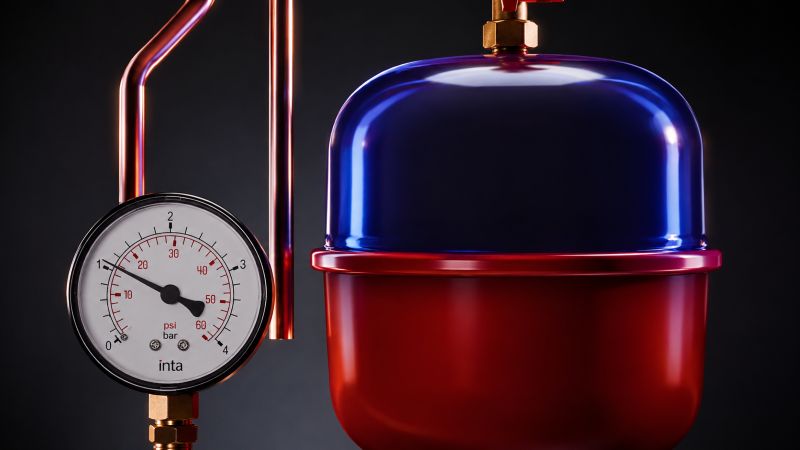
George Knowles, Project Engineer at Zilmet UK, opens up the CAL-PRO expansion vessel and explains what is happening inside one of the most familiar components in a sealed heating system.
Expansion vessels are often treated a bit like a health check-up: easy to ignore until something feels off, starts making a noise, or refuses to behave as it should. Every time a sealed heating system warms up and cools down, the expansion vessel is there to absorb changes in water volume and keep pressure under control.
That is why installers often fit trusted products by default, but reliability is not magic. Inside every effective expansion vessel is a simple piece of engineering doing an important job.
For installers, the expansion vessel usually becomes interesting at the exact moment nobody wants it to. A customer calls because the pressure has climbed too high. The PRV has discharged. The gauge has dropped again. Someone has topped the system up for the third time and is now convinced the boiler is at fault.
At that point, the small red vessel in the background is no longer just a familiar fitting on the wall. It becomes part of the investigation.
What’s inside and how it works
There is no wizardry inside a CAL-PRO expansion vessel. Just a steel shell, two separate sides, and a diaphragm doing more work than its simple appearance suggests.
The shell is divided into a water side and an air side, separated by a flexible SBR rubber diaphragm. The water side connects to the heating system, whether that is water or a water and glycol mix. The air side contains the pre-charge. The diaphragm keeps the two separated while allowing controlled movement inside the vessel.
As the system heats up, water expands and enters the vessel, pushing the diaphragm towards the air side. The air compresses, creating a cushion for the extra volume and preventing pressure from rising too sharply. When the system cools, the process reverses. The compressed air pushes the diaphragm back, and water returns to the system.
That cycle happens again and again. The vessel gets very little credit when it is working properly. It simply takes the pressure, gives the system room to breathe, and gets ready for the next heating cycle.
What goes wrong, and why it can be hard to spot
The most common failure mode that is not immediately obvious is waterlogging. If the diaphragm fails or develops a pinhole, water gets into the air side. The vessel becomes a solid mass of water with no air cushion and can no longer absorb expansion at all. The symptoms — rapid pressure rise, PRV discharge and pressure drop — can look the same as an undersized or incorrectly charged vessel, which is why diagnosis matters before replacement.
The quickest check: press the Schrader valve on the air side. If water comes out rather than air, the diaphragm has failed.
The Schrader valve and pre-charge
Most installers know the Schrader valve is there, but its role is worth spelling out. It is how the pre-charge is set and checked, and it works exactly like a tyre valve. Pre-charge should always be checked with the system depressurised and cold. With pressure in the system, the reading is meaningless.
The pre-charge pressure is not a guess. The vessel’s air pre-charge should match the cold fill pressure of the system. Set it too low and the vessel will not engage properly. Set it too high and the diaphragm is already partly compressed before the system fires up. That reduces how much work the vessel can do from the start.
Diaphragm versus bladder, and fluid compatibility
Not all expansion vessels work the same way internally. CAL-PRO uses a fixed diaphragm. Other vessels use a bladder. Both absorb expansion, but they do it differently. A diaphragm separates the air and water. A bladder fills internally with water, like a balloon, and is surrounded by an air jacket. This design difference can also affect maintenance. If the diaphragm fails, the vessel usually needs replacing. With some bladder vessels, the bladder itself may be replaceable.
SBR rubber also has a defined working temperature range. Most domestic applications sit comfortably within it, but in higher-temperature systems, or where there is a high level of glycol in the system, it is worth checking if the vessel is suitable for the job.
Sizing matters
Getting the vessel size right matters. Too small and it cannot accept the expanded water volume in the system. Too big and it is simply taking up space it does not need. The Zilmet website has a sizing calculator for any installation, and Cal, the Zilmet chatbot, has access to full technical and sizing information if you need guidance. There is also an engineer available on the phone if you would prefer to talk it through.
Many installers fit CAL-PRO because it is familiar and trusted. On a busy job, that matters. That is why the inside of the vessel is worth understanding. Not to make a familiar product feel more complicated, but to show why the basics matter: correct sizing, correct pre-charge, reliable construction and a diaphragm that can keep doing its job cycle after cycle.
It sits quietly on the system, taking the pressure in the background while everything else gets the attention. No drama, no fuss, and ideally no awkward call-back where everyone stands around looking at the gauge.
Image: Inta – Zilmet