
Maintaining the correct inhibitor concentration is important for reliable and efficient central heating systems. Here, Richard Crisp, Head of Chemistry at Fernox, offers a reminder of the role inhibitor plays, and goes on to explore the water quality testing options available, that can help to carry out this valuable task.
Installers are well aware that when untreated water comes into contact with metal components, corrosion occurs, leading to sludge, limescale and the build-up of other system debris over time. Inevitably, this reduces system efficiency, increases the risk of boiler breakdown, and forces the system to work harder than it should have to.
None of this is good news for the homeowner, who quite literally pays the price with higher energy consumption and increased energy bills. More carbon emissions also means bad news from an environmental standpoint. However, all of this is thankfully avoidable – if central heating systems are properly protected and maintained.
This is why the British Standard code of practice for the preparation, maintenance and commissioning of domestic heating systems (BS 7593:2019), states that using a high-quality corrosion inhibitor, also known as a protector, in a central heating system is essential. It plays a fundamental role in keeping systems energy efficient because adding an inhibitor will help to prevent the formation of corrosion and limescale in the first place, as the system’s metal surfaces will be chemically protected.
This is a fact further supported by The Benchmark Commissioning Checklist, which asks installers to go the next step and also verify the type and brand of both cleaning and inhibitor products used during the commissioning stage.
This is also underpinned in Part L of the Building Regulations in England, which incorporates measures to reduce CO2 emissions and keep central heating systems working efficiently. Therefore, every heating system installation, repair and service carried out in a domestic environment must be carried out in accordance with BS 7593:2019.
Annual on-site testing
It is crucial to ensure that the correct levels of inhibitor are maintained throughout the life of a system, to reduce the risk of breakdowns and optimise its efficiency.
BS 7593:2019 also requires regular testing of the system water. A best practice approach means that both on site annual testing and full system laboratory testing every five years should be conducted.
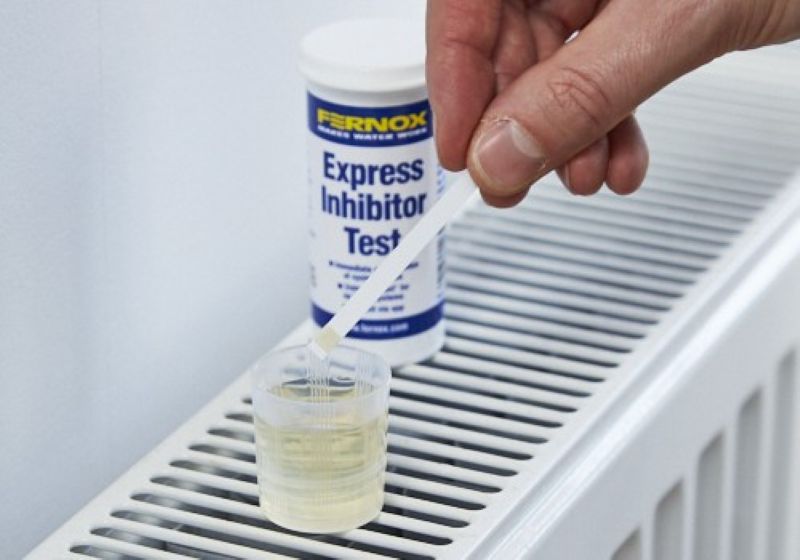
If a system is fully protected, it will have inhibitor levels of 100ppm or above. The Fernox Express Inhibitor Test is a great example of a go-to option that offers a quick result about the level of inhibitor in a central heating system. By simply dipping the test strip into the system water, installers can ascertain if re-dosing is needed just by referring to the colour displayed on the dipped strip and comparing it to the colour chart on the bottle.
The Fernox Express Inhibitor Test can also be used in conjunction with the Fernox App, which saves the results and produces a lab-style report certificate.
Laboratory testing
A heating system must either be re-dosed at five-year intervals or undergo a full laboratory analysis during the same period, with redosing as required. Kits are available to help installers collect water samples for accurate laboratory testing.
There are also laboratory tests that can be accessed via smart phones. Leading manufacturers such as Fernox provide a paperless postal laboratory service to provide a system diagnostic check of five, key water quality criteria including appearance, pH, conductivity, protector concentration and cleaner residue.
Results allow installers to ensure that the correct levels of inhibitor are present and to check if there is any cleaner residue in the system if it has been powerflushed, as this could increase the rate of corrosion in a system if it isn’t properly removed.
By taking advantage of a more comprehensive testing method such as this, installers can also receive recommendations from a specialist team, about the most effective means of treating the system to restore efficiency and extend its service life.
Testing, testing…
When it comes to making sure central heating systems are protected, on site system testing is a sure-fire way of making sure inhibitors levels are correct. Then given the ease of which far more detailed systems analysis can be accessed, it is worthwhile looking at the options available if you haven’t before, particularly when faced with a problematic system or a customer who would like detailed insight when provided with a quote.
By undertaking system testing, installers are using all powers at their disposal to keep systems efficient and effective and to comply with best practice requirements and industry codes of practice.
Image: Fernox