
Ben Perris, Sales Director for Indoor Climate Solutions at Wavin, provides some thoughts on Underfloor Heating.
Q. What are the main benefits ofunderfloor heating (UFH)?
UFH offers homeowners improved comfort and efficiency by delivering uniform heat at lower temperatures. For installers, it’s a reliable, future ready option that helps them guide customers toward smarter, energy efficient heating choices.
For consumers, it delivers consistent, even heat distribution in the room, eliminating cold spots and delivering comfortable temperatures quickly in the home. The addition of controls like Wavin’s Sentio, helps to take this one step further by allowing for zoning control, enabling homeowners to optimise which areas are heated at any given moment, maximising energy efficiency within the home.
UFH systems also operate at much lower temperatures (35oC – 55oC) compared to traditional convection radiators (65oC – 88oC), making them an efficient choice, well suited to today’s energy-conscious consumer.
Q. What factors should plumbers consider before selecting a system to use?
Before selecting a system to use, installers must have a full understanding of the project ahead. Factors such as property type, available floor build-up height, heat output requirements, floor construction, whether the site is a new build or a retrofit project, and the project timeline itself, can heavily impact decision making when it comes to selecting a system to use.
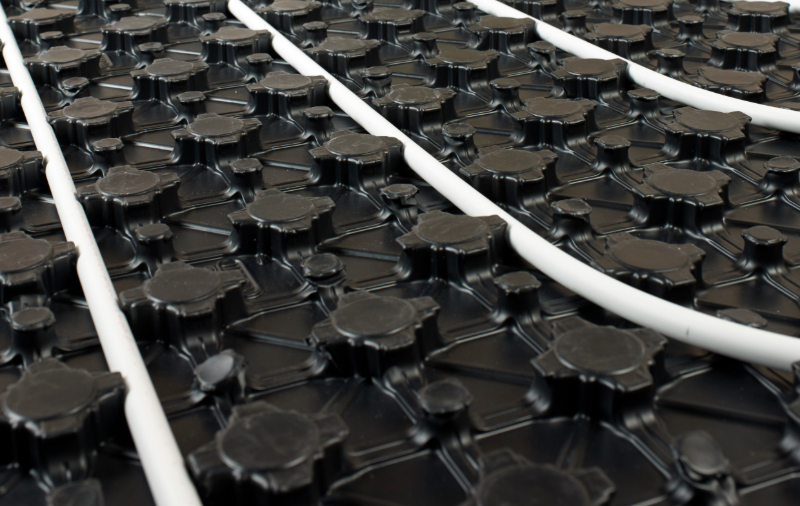
For example, on projects where floor build-up height must be carefully managed (e.g. upstairs installations) installers select solutions such as Wavin WarmDeck. With Wavin WarmDeck, the heating system is built directly into the structural deck of the floor, housing the heating pipework within the floor structure – making upstairs UFH possible.
Q. Do you have any installation advice for installers fitting UFH?
Preparation is key. You should always start by reviewing whether the system design and pipe layout is an appropriate fit for the work you’ll be completing as the type of job you’re undertaking may call for a different UFH system entirely.
For example, installers who are retrofitting systems may benefit from the use of low-build panel systems. This is because these solutions minimise the impact on floor height, reduce disruption, and allow installers to integrate UFH into existing properties without extensive construction work.
Installers should also consider the style of flooring their customer has and ensure it provides the best match to deliver consistent warmth and energy efficiency throughout the room. Tile flooring, for example, is one of the most efficient surface finishes for UFH thanks to its excellent thermal conductivity, allowing heat to transfer quickly and evenly.
“Installers tasked with newbuild projects may look towards installing staple based UFH systems, which offer flexibility, reliability and suitability for projects where floor construction is being completed from scratch.
Q. Are there any features that allow for simplified installation?
Wavin’s UFH systems have been designed following consultation with experience installers from across the UK to make installation quicker and easier to handle on site.
Our systems are designed with lightweight, low-profile pre-engineered components that work seamlessly together – including high-quality, flexible pipework, intuitive manifolds and fixing systems that make pipe placement quick and secure.
Q. What kind of controls should be used with UFH?
Controls play a vital role in getting the most out of an UFH system. Installers should recommend smart, responsive controls that allow homeowners to manage their heating efficiently across different zones of the property. Wavin’s Sentio Controls give homeowners intuitive, room by room temperature control through the Sentio mobile app, allowing quick and easy adjustment of settings.
The system is also designed to minimise the unnecessary cycling of a heat pump, helping it run steadily and efficiently. This not only reduces running costs but also helps prolong the operational lifespan of the heat pump. This level of flexibility and optimisation supports better system performance and helps users meet their energy efficiency goals.
Q. What kind of support is available from Wavin for installers using UFH on a project?
Installers working with Wavin benefit from a strong support network throughout the whole project lifecycle. Through the Wavin Installer Network (WIN), installers can access technical guidance, system design support, training opportunities and practical installation resources. This helps to ensure that every installation is carried out with confidence.
WIN is a completely free to join initiative designed to help ensure that installers have direct access to manufacturer expertise, and that each project is complete with fast problem solving, the most reliable system performance and added confidence when specifying UFH solutions to customers.
Q. Can UFH be used with both traditional boiler systems and Heat Pumps?
UFH systems are compatible with both traditional boiler systems and modern heat pumps. Though, because UFH operates at lower temperatures (35oC – 55oC), it works particularly well with heat pump technology, making it a future-ready and efficient heating solution.
The systems from Wavin are designed to integrate with a wide variety of heat sources, allowing installers to confidently specify UFH in both new build and retrofitted projects.
For installers, the flexibility of UFH means that they can offer a solution that works across different heating setups. This gives them greater versatility, helping them to stay aligned with the demands of a growing market for low-carbon heating systems.
Image: Wavin