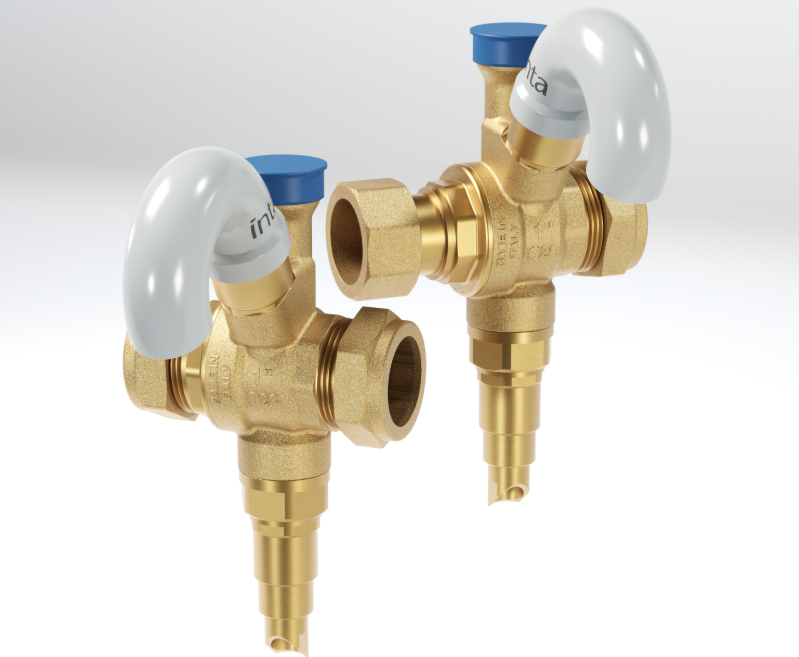
Inta’s new Zero Plus anti-freeze valve has been designed to protect air source heat pumps against freezing, can be insulated to reduce heat loss and incorporates isolation to make installation and servicing simpler.
The patent-pending design combines the protection of the original Inta Zero with a fully integrated isolation valve. One compact unit replaces two separate components, giving installers fewer connections to make, fewer potential leak points and a more compact installation where space is tight.
Its thermostatic element sits directly in the system water flow, opening the valve when the water temperature falls to 3°C and closing again at 4°C. Discharging water as it approaches freezing helps prevent ice forming in the heat pump circuit and causing costly damage.
Zero Plus can be fitted with a purpose-designed insulation jacket, helping installers maintain insulation across the external pipework and fittings and limit heat loss during normal operation.
A tapered anti-drip outlet helps prevent discharged water freezing into a blockage, while an internal protective ring helps keep system debris from interfering with operation. The company says a low-friction, nickel- and PTFE-coated operating piston and double O-rings support reliable movement even after long periods without activation.
Inta’s Zero Guard is supplied as standard, protecting the anti-vacuum air inlet against dirt, leaves and insects.
The new integrated isolation valve also allows the temperature-sensing or anti-vacuum components to be inspected or replaced without draining the system, reducing maintenance work and disruption for the customer.
Stuart Gizzi, CEO of Inta, said: “An anti-freeze valve might sit there for years without needing to open. When it does, it has to work. That means thinking about everything that could stop it, from debris inside the system to ice blocking the outlet.
“Zero Plus keeps those protections and makes the installer’s job easier. There is no separate isolation valve to fit, you can insulate it to keep heat in the system, and the working components can be serviced without draining it. Those are benefits during installation and throughout the life of the system.”
Image: Inta