

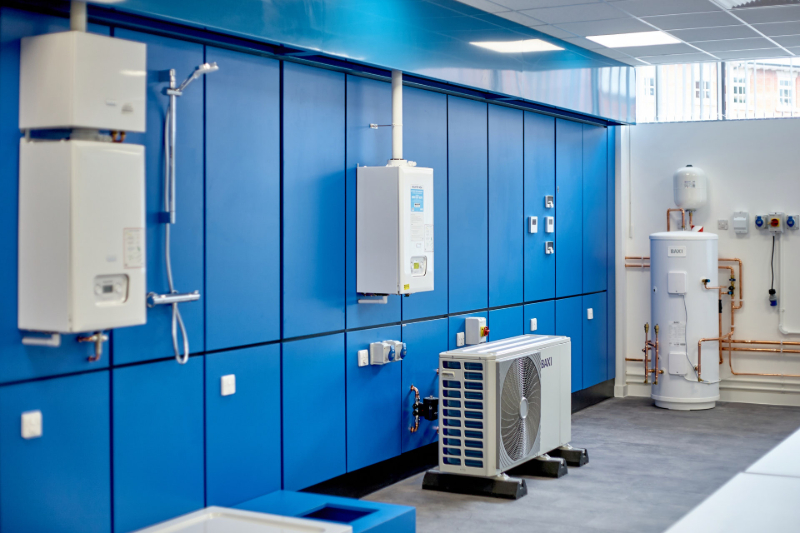
Ian Trott, Head of Training Solutions at Baxi, outlines the routes available to heating installers ready to capitalise on the growing demand for air source heat pumps.
The case for adding air source heat pumps (ASHPs) to an installer’s offering has never been stronger. Baxi’s Installer Skills Survey highlighted that more than half (59%) of UK heating engineers are either already or likely to work towards heat pump competencies. Government incentives, such as the Boiler Upgrade Scheme (BUS), are driving enquiries towards low-carbon heating. Installers who can meet that demand are well-positioned to unlock new revenue streams, diversify their workload and differentiate themselves in a competitive market.
Taking advantage of this opportunity requires both competence and confidence. Customers expect knowledgeable heating engineers to deliver the right solution at the right price. A structured approach to upskilling gives installers the foundation to deliver on customers’ expectations while broadening the range of projects they can take on.
While the journey to confident ASHP installations can seem daunting, it doesn’t need to be. Some great options are available, including product awareness sessions, training courses and practical on-site support, that allow installers to build knowledge at a pace that suits their business. Together, these options form a comprehensive framework for entering the heat pump market.
Awareness
Product awareness sessions offer a practical entry point for installers exploring ASHPs. Short and relaxed, these sessions provide hands-on exposure to heat pump units, cylinders and controls alongside an overview of wiring fundamentals and system design principles.
They also flag compliance essentials. Participants learn about how MCS accreditation is a requirement to obtain BUS grant funding – all of which will shape how ASHP projects are quoted and delivered.
These sessions serve a dual purpose. They allow installers to become familiar with the practices of ASHP installation, understanding where they could fit in their portfolio and highlighting resources such as technical guidance portals and loyalty programmes that support engineers as their heat pump workload expands.
Building capability
While an awareness session builds familiarity, structured training is necessary to build competence. Dedicated heat pump installer courses are the logical next step, combining design and application content with hands-on installation and fault-finding modules.
The design element covers sizing, flow-rate considerations, buffer vessel selection and emitter matching, while installation content focuses on site preparation, hydronic and electrical connections, commissioning procedures, and diagnostics. Qualified engineers deliver the training at dedicated academies and venues across the UK, blending discussion with practical experience. Baxi’s Heat Pump Installer course is one such option, starting with design and application, a self-paced e-learning course, followed by a day of hands-on installation and commissioning practice.
As almost every customer installing a heat pump will want to claim available government grants, Baxi also offers the BPEC Accredited ASHP Systems course. This covers the principles of design, installation, commissioning, and servicing of ASHP systems, including water regulations.
Commissioning deserves particular attention. It is the point at which design and installation become a ‘live’ system. Great design and installation are nothing without good commissioning, and the BHPI course is designed to deliver optimum outcomes, with free assisted commissioning on the first installation. Optimal commissioning leads to better heat pump performance, satisfied customers and enhanced warranty eligibility. Manufacturer-led commissioning supervision on early installations gives newly qualified engineers a safety net, guiding them through control setup and customer handover before they take on projects independently.
MCS support
Technical skill is part of delivering an ASHP project. Being adept at the administrative process is equally important to ensure a smooth handover and maximise available government grants. While many installers will happily undertake this task, for others, keen to concentrate on the installations themselves, MCS Umbrella Schemes will provide a welcome alternative.
Baxi’s MCS Umbrella Scheme is one example, handling design, compliance and paperwork on the installer’s behalf so they can concentrate on the physical installation. As a first step, our team will provide an estimation of the size of the heat pump needed to deliver comfort to the homeowner in readiness for the installer to build their quote.
Once the homeowner is happy to progress further, our engineers then carry out an in-person site survey leading to a comprehensive heat loss report and detailed system design. This includes everything from radiator sizes to pipework calculations, so that the installer can provide a final project proposal for the customer. We will also provide a complete parts list for installers to source from their preferred merchant. If accepted, we then administer the MCS paperwork on the installer’s behalf, freeing them up to move forward with the installation work itself.
As part of the service, we also check the property’s eligibility for the Boiler Upgrade Scheme (BUS), taking care of the compliance and MCS paperwork needed to access the grant funding.
A defined pathway
The route from ASHP awareness to confident, compliant installation is well established. Awareness sessions provide the foundation, structured courses build technical capability, and Umbrella Services help installers concentrate on the areas in which they excel.
The demand for ASHPs is there, as is the manufacture infrastructure to support new installers. Those who act early will be the ones best placed to build sustainable, future-ready businesses as the sector continues to evolve.
Image: Baxi