Stephen Elsmore, Senior Technical Support, Altecnic, takes a look at a safety and performance component in unvented hot water systems, Inlet control groups.
Q. What is an inlet control group?
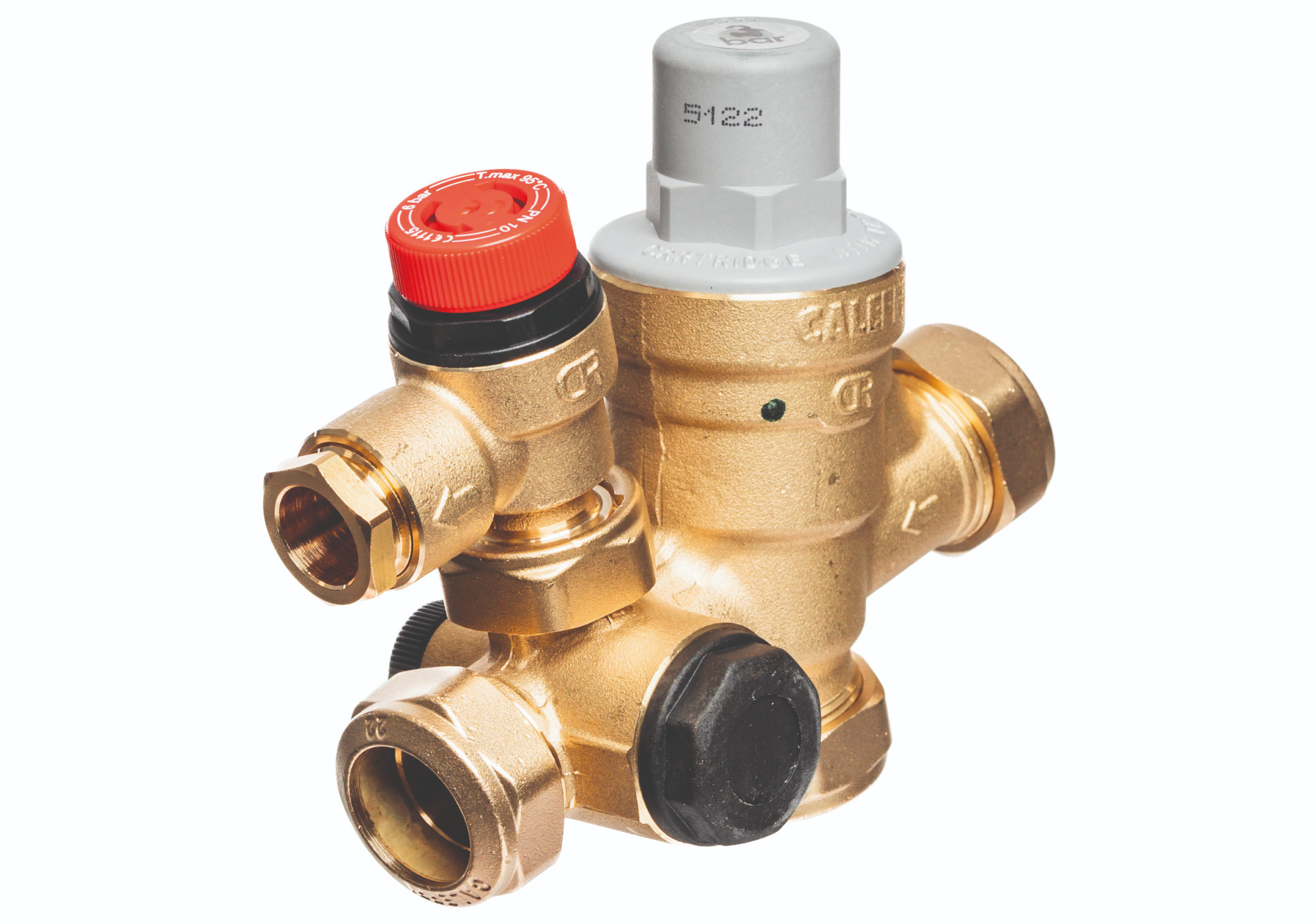
An inlet control group is a pre-assembled manifold fitted to the cold water supply of an unvented hot water system. It combines several essential control and safety components into one compact unit, reducing installation complexity and helping ensure compliance with Building Regulations (including G3 in the UK).
Its primary role is to regulate, protect, and control the cold water entering the system.
Q. What components are typically included?
A standard inlet control group includes:
– Pressure reducing valve (PRV)
– Check valve (non-return valve)
– Safety relief valve (SRV)
– Strainer/filter (on most models)
These components are factory-matched to work together at specific pressure settings.
Q. What does the pressure reducing valve do?
The pressure reducing valve (PRV) limits and stabilises incoming mains water pressure to a preset level (commonly 3 bar).
Why this matters:
– Mains pressure is often too high or inconsistent for unvented systems
– Excessive pressure can damage cylinders, valves, and downstream components
– Stable pressure improves appliance performance and reduces wear
The PRV ensures the system operates within its designed pressure range regardless of fluctuations in the supply.
Q. What is the role of the check valve?
The check valve prevents water from flowing back from the cylinder into the mains supply.
Key functions:
– Stops expansion water from pushing back into the cold supply
– Protects water quality by preventing contamination
– Maintains correct system operation
This component is essential for regulatory compliance and safe system operation.
Q. How does the safety relief valve work?
The safety relief valve (SRV) provides final protection if system pressure rises above safe limits (typically 6 bar).
When it operates:
– Failure of the PRV
– Thermal expansion issues
– Blocked pipework or downstream faults
If the valve opens, excess pressure is safely discharged to drain via a tundish. Regular discharge indicates a system fault and should never be ignored.
Q. How do these components work together?
The inlet control group operates as a pressure management sequence:
– The PRV reduces and stabilises incoming mains pressure
– The check valve prevents reverse flow and maintains system integrity
– The relief valve protects against abnormal pressure rise
Together, they ensure consistent hot water delivery while safeguarding the system and meeting safety regulations.
Q. Where should an inlet control group be installed?
The inlet control group must be installed:
– On the cold water supply pipe
– Upstream of the unvented hot water cylinder
– After the main isolation valve
– In the direction of flow indicated on the valve body
Most units can be installed horizontally or vertically, provided access is maintained for inspection and servicing.
Q. What are best practices for installation?
Installers should ensure:
– Correct orientation and flow direction
– Relief valve discharge is piped to a safe, visible drain point
– Adequate space is left for servicing and replacement
– Pipework is properly supported to avoid strain on the manifold
Always follow both the inlet control group and cylinder manufacturer’s instructions.
Q. How should inlet control groups be tested?
During commissioning and routine servicing:
– Confirm correct downstream pressure after the PRV
– Check for leaks at compression joints
– Inspect the relief valve discharge pipe for signs of operation
– Verify isolation valves function correctly
Any unexplained discharge or pressure instability should be investigated immediately.
Q. What maintenance is required?
Although inlet control groups are largely maintenance-free, periodic checks are recommended:
– Inspect the filter/strainer for debris (if serviceable)
– Check relief valve discharge for signs of frequent activation
– Confirm pressure remains within specification
Servicing should be carried out by a qualified engineer as part of regular system maintenance.
Q. What are common faults and how can they be identified?
Reduced flow rate
– Blocked strainer or debris in the PRV
Frequent safety relief valve discharge
– Failed PRV
– Expansion vessel issues, such as:
– Loss of pre-charge in vessel
– Incorrect vessel installation
– Excessive incoming pressure
Noise or vibration
– Incorrect installation orientation
– High flow velocity or pressure fluctuations
– Early diagnosis helps prevent component failure and system downtime.
Q. Why are inlet control groups essential for compliance?
Inlet control groups help ensure unvented systems meet safety and regulatory requirements by:
– Controlling pressure at the point of entry
– Preventing backflow into the mains
– Providing visible pressure relief in fault conditions
Correct selection, installation, and maintenance are essential to system safety and long-term performance.
Always follow both the inlet control group and cylinder manufacturer’s instructions.
Image: Altecnic