

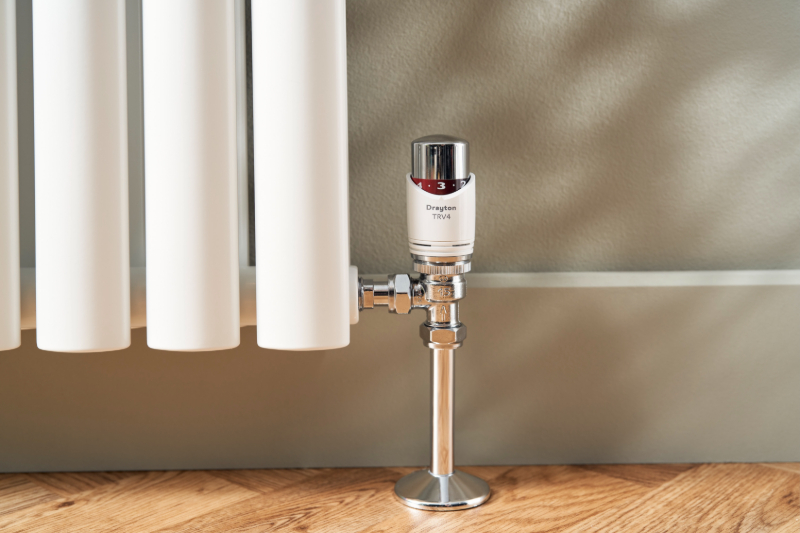
Merlin Milner, Product Owner for Water-based Systems at Drayton, discusses how components such as TRVs play an important role in delivering high-performing, future-ready solutions that are fully aligned with building regulations.
Part L of the Building Regulations in England and Wales aims to reduce energy consumption and carbon emissions of buildings. It states that when working on any replacement or new heating system, the installer must ensure that TRVs are added to every radiator except those in whichever room houses the central thermostat. It also states that the system is commissioned to be as efficient as possible, which can only be achieved through system balancing.
Additionally, the Benchmark scheme is a regulatory checklist that was developed to improve domestic heating standards. As part of this, installers are legally required to carry out a commissioning checklist for every job they complete to ensure each one complies with the appropriate Building Regulations of England and Wales. An update to the scheme in 2019 saw system balancing added to the list of requirements, so it is vital that this is correctly carried out.
A balanced system enhances the overall health of a heating system, including supporting correct boiler condensing which leads to maximising efficiency and lower energy bills.
Even distribution
System balancing means that hot water is evenly distributed to all radiators within a house. If a system is not correctly balanced, this leads to cold spots in the property as radiators further away from the boiler will heat up slower and struggle to reach temperature in comparison to those closer to the boiler, which would heat up faster. This compromises the comfort of the home and is frustrating for homeowners, particularly when the boiler is functioning properly. Typically, this can lead to homeowners turning up their heating to make their house warmer which consequently leads to using more energy, or lead to call backs.
Therefore, having a balanced system means that there is uniform heating around the entire property – avoiding any cold spots. This reduces call backs for installers as the system performs as expected, as well as improves comfort so that homeowners don’t need to keep increasing the temperature of their heating. Each of these factors lead to savings of time for the installer, and money for the homeowner.
A balanced system
Traditionally, system balancing was a time-consuming procedure that involved using lockshield valves and manually measuring the temperature difference (delta T) across each radiator. Despite being effective, balance could be lost over time due to system changes or TRVs being opened or closed, and therefore meant that maintenance was difficult for installers to achieve and homeowners to maintain.
In more recent years, TRVs have helped simplify system balancing by reducing reliance on the traditional lockshield valve. Instead, some models can be adjusted using a unique balancing key, allowing installers to set and fix the flow rate more precisely. Once set, the position can be locked to prevent tampering, to enhance consistency. However, it still requires the installer to work to the 20ºC temperature difference between flow and return.
Auto balancing
Taking this a step further, auto-balancing TRVs, such as those available from Drayton, remove even more manual effort from system balancing. After initial setup, they automatically regulate the flow through each radiator in response to system demand, always ensuring the correct distribution of hot water. This not only eliminates the need for ongoing manual balancing but also maintains system performance regardless of adjustments made elsewhere.
Auto-balancing TRVs are key to reducing time spent on balancing heating systems while ensuring that homeowners still enjoy a high-performing, efficient heating system that is ready for the future and easily complies with Part L and the Benchmark commissioning checklist.
Many auto-balancing TRVs, including those from Drayton, have been designed with the same dimensions as GB-pattern valve bodies to support easy retrofitting, boiler upgrades or full-system replacements. As an example, Drayton’s Auto-balancing RT414 TRVs are specifically designed for UK domestic heating systems, ensuring they can be seamlessly integrated into homes to improve performance, reliability and compliance, while also being in-keeping with the aesthetics of a property.
By improving the performance of the heating system with auto-balancing TRVs, installers can deliver lower energy bills as well as consistent comfort throughout the property for their customers.
Auto-balancing technology also ensures that the system will remain permanently balanced for years to come, despite the opening and closing of other TRVs or any other changes being made to the system.
Impactful results
Boosting efficiency and keeping energy consumption down remain a priority for many homeowners in the current economy, and installers are playing a key role in achieving this for their customers. Ensuring heating systems are optimised and compliant as we try to make home heating more sustainable not only leads to savings, but also to a reduction in carbon emissions from fossil fuelled gas boilers.
By fitting auto-balancing TRVs instead of traditional TRVs and focusing on system balancing as part of every installation, heating engineers can easily deliver more efficient homes, while simultaneously building trust among their customers.
Image: Drayton