
Jim Perry, Senior Consultant, Water Hygiene Centre explores how jointing compound may impact water systems.
Plumbing jointing compounds (or pastes as they are also known as) have been a trusted part of water system installation practice for decades, which is applied to the threads of compression fittings to create a watertight seal, these jointing compounds still remain widely used in domestic hot and cold water systems, commercial buildings, and healthcare environments.
As standards evolve and our awareness of water safety improves, so too must our approach to these jointing compounds. Over recent years there have been changes to WRAS (Water Regulations Advisory Scheme) testing and certification for these products, alongside some concerns about potential bacterial contamination issues linked to compound overuse, meaning that installers and project / estate managers must now think more carefully than ever about product selection and application.
This article explains what has changed and why knowing exactly what jointing compound is being used on a domestic hot and cold water system matters for compliance, performance, and public health.
WRAS Testing: From 85°C to 23°C. What’s Changed?
For many years, WRAS approval testing for jointing compounds was carried out at up to 85°C, a temperature chosen to reflect typical domestic hot water systems, this assured installers that a product approved by WRAS was safe for contact with potable water in both cold and hot systems. However, WRAS’s testing laboratory has now revised its testing methodology, reducing the test temperature to 23°C.
This shift aligns with European standard testing protocols, which traditionally uses room temperature conditions when assessing whether any substances may migrate into drinking water.
Does this mean WRAS approved compounds are no longer suitable for hot water?
Not necessarily, as the key distinctions are:
– WRAS approval confirms water safety at room temperature
– The manufacturer must confirm temperature suitability for hot water (however, may refer back to the WRAS approval).
Taking the above on board, this means installers must check the technical data sheet and not to just rely on a WRAS badge to confirm maximum recommended operating temperature.
Why the change matters
Some water systems such as those in healthcare operate under strict control requirements / regimes defined in documents such as HTM:04-01.
Using the wrong product in a healthcare setting could:
– breach compliance requirements
– compromise water quality
– create risk for vulnerable patients
So, the WRAS adjustment isn’t a limitation, but a gentle reminder that approvals and temperature ratings must be checked together.
Other Relevant Approvals: BS 6920 / KIWA / NSF
WRAS is not the only certification to review or consider when choosing jointing compounds:
| Approval | What it Confirms | Why it Matters |
| BS 6920 | Product is chemically safe when in contact with drinking water. | Protects taste, odour, colour, and water chemistry. |
| KIWA | Meets strict European water safety and stability standards. | Essential for global and high-specification projects. |
| NSF | International potable water safety certification. | Recognised globally across commercial sectors. |
Products supported by several certifications have the potential to provide stronger assurance of long-term safety, especially where uncompromised water quality in high-risk areas is paramount.
The hidden issue: overusing jointing compounds
Jointing compounds can work well when applied correctly, but overuse / application can be a common and costly mistake, which can lead to serious water quality problems.
What goes wrong when too much compound is applied:
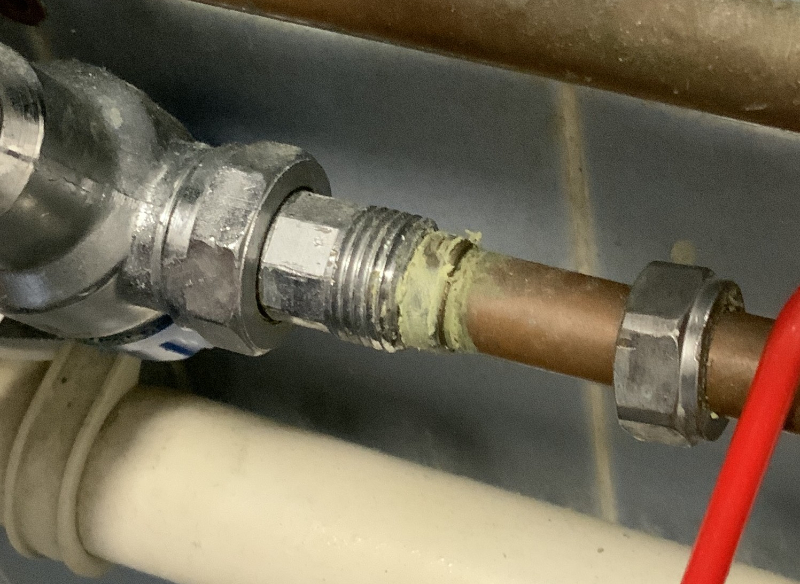
– It has the potential to be pushed into the pipework during tightening
– The excess travels through the system
– It can accumulate in valves, strainers, aerators, or filters
– Where the compound is captured, it can provide an area for biofilm formation which can lead to microbial growth / contamination
– Restriction in flow where the compound has settled in valves, strainers, aerators, or filters.
In severe cases, this can:
– Reduce operational performance
– Cause valve malfunctions
– Increase maintenance for cleaning
– Compromise overall water quality, leading to adverse microbiological sample results.
Best practice application (if required as a last resort)
A safe and hygienic installation requires:
– A thin, even application only on male threads
– Avoiding smearing compound into fittings or pipes
– Post-installation flushing (with no restrictions i.e., filters, strainers in place) to clear any residue
– Selecting only the amount of compound that required to complete the task.
If compound squeezes out when tightening a fitting it is evident that too much compound has been used.
Why some subject matter experts recommend reducing or avoiding use:
Due to the potential water quality concerns, it has become apparent in project specifications that the use of jointing compounds is to be avoided wherever possible, especially in water systems containing:
– Thermostatic Mixing Valves / Taps (TMVs / TMTs)
– Fine strainers (e.g., inline Y-strainers)
– Tap filters / aerators.
Alternatives include, but not limited to:
– PTFE (Teflon) tape or cord
– Pre-formed sealing washers (Non EDPM).
The above options create an effective seal without introducing excessive debris into the domestic water systems, with the below results:
– Reduced risk of bacterial growth
– Longer system lifespan
– Simplified compliance
– Lower maintenance and callouts
Summary
Jointing compounds may remain an important part of plumbing practice, but their use must be smarter and better informed than previously. The WRAS test temperature change from 85°C to 23°C does not prohibit hot water use; instead, it emphasises the responsibility of installers to verify suitability and prioritise system hygiene.
By ensuring the correct product choice, using minimal quantities, and exploring safer alternatives where appropriate, we can protect both the water system performance and public health, along with the safety of the end user from any potential infection issues.
* The information provided is from a blog on the Water Hygiene Centre website. It is correct as of the date of original publication – November 2025.
Image: Water Hygiene Centre