
Hard water affects millions of homes and buildings across the UK, resulting in hidden limescale buildup that can slowly reduce energy efficiency, increase operating costs, and shorten the lifespan of heating and hot water systems.
Electrolytic anti-scale devices, like the Caleffi eCAL®, tackle this problem at the source. Rather than treating water chemically or trapping scale after it forms, these devices prevent limescale from forming in the first place by using a low-energy, chemical-free electrolytic process.
But what exactly is inside these devices, and how do each component contribute to scale prevention? Ed Morris, Technical Manager at Altecnic, takes a look inside the Caleffi eCAL®.
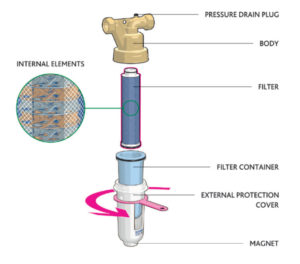
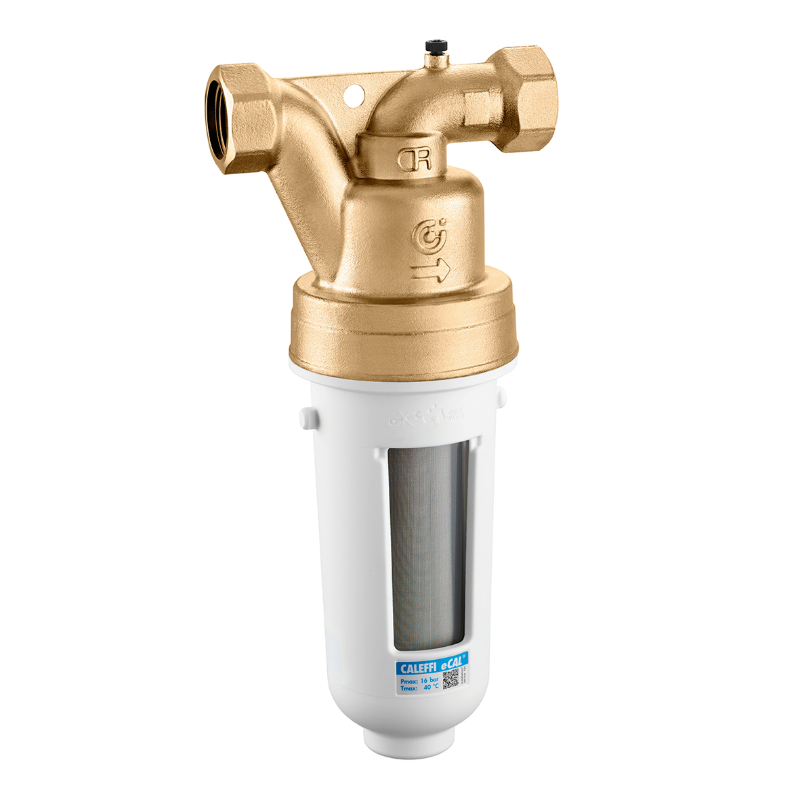
Caption: Caleffi eCAL® Diagram
1 Brass Body
The outer body of the eCAL® is made from high-grade brass, chosen for its strength, corrosion resistance, and thermal stability. It forms a sealed, pressure-rated chamber that allows the electrolytic process to take place safely and consistently over the system’s lifespan.
2 External Protection Cover
A twist-release outer cover protects the internal components while allowing quick access for inspection or flushing. This makes routine maintenance simple without disrupting system hydraulics.
3 Pressure Drain Plug
Located at the base of the device, the pressure drain plug provides a safe and efficient way to discharge captured debris during cleaning cycles. This helps maintain optimal water flow and ensures that separated particles do not re-enter the system.
4 Internal Filter
At the top of the device sits a 50μm stainless-steel mesh filter with a large surface area. Inside the eCAL® it:
– Creates turbulence to energise the water flow
– Mechanically separates larger impurities
– Helps direct water toward the electrolytic chamber
Because of its wide surface and mesh size, clogging is far less likely than with traditional inline filters.
5 Integrated Magnet
Positioned in the lower chamber, the magnet never touches the water directly but efficiently traps ferromagnetic particles such as iron oxides. This supports total system protection by removing debris that can damage pumps, valves, and heat exchangers.
6 The Electrolytic Cartridge
This is where the transformation happens.
Inside the cartridge are titanium and copper alloy discs (Zn/Ti) arranged in series. As water passes through them:
1 A low-voltage potential difference is generated, creating a ‘battery effect’.
2 A controlled electromagnetic field influences calcium and magnesium ions.
3 A vortex effect caused by the spiral disc geometry enhances crystallisation.
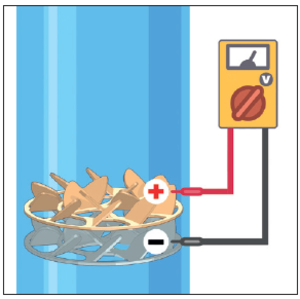
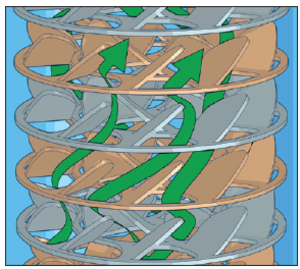
Caption: Battery effect (left) Vortex effect (right)
Instead of forming calcite, a hard, adhesive crystal that causes scale, the eCAL® encourages the formation of aragonite microcrystals:
– They do not stick to surfaces
– They stay suspended in the water
– They are carried harmlessly out of the system
Water hardness is unchanged as only the behaviour of the ions is modified.
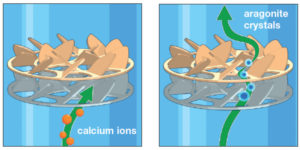
Caption: Calcium ions turning to aragonite crystals in the electrolytic cartridge
7 Flow Reversal Chamber
After the water passes the magnet, the device forces flow reversal, ensuring 100% of incoming water enters the electrolytic cartridge. This guarantees continuous treatment under all operating conditions, even at low flow rates found in modern heat pumps and district heating systems.
How this Works for System Protection
As water travels through the eCAL®:
1 Filter mesh removes larger particles and induces turbulence.
2 Magnet captures ferromagnetic debris.
3 Electrolytic discs convert calcium behaviour from scale-forming calcite to harmless aragonite.
4 Microcrystals remain suspended and are flushed away naturally.
This means:
– No chemicals or salts
– No impact on water hardness
– No moving parts
– No interference with system operation
Why it matters…
As the UK pushes forward with low-carbon heating solutions, through the use of heat pumps, district heating networks and high-efficiency hot water systems, maintaining system performance becomes increasingly critical. These technologies operate at lower temperatures and tighter tolerances, making them far more sensitive to limescale than traditional boilers.
Understanding what’s inside the electrolytic anti-scale devices, like the Caleffi eCAL®, is therefore essential, with every internal component playing a role in preventing scale before it forms, rather than reacting after damage has occurred.
By combining filtration, magnetic separation and electrolytic crystal conversion within a single compact device, these devices safeguard heat transfer efficiency, reduce maintenance intervention and support long-term system reliability.
Watch an explainer video on the Caleffi eCAL®
Images: Altecnic