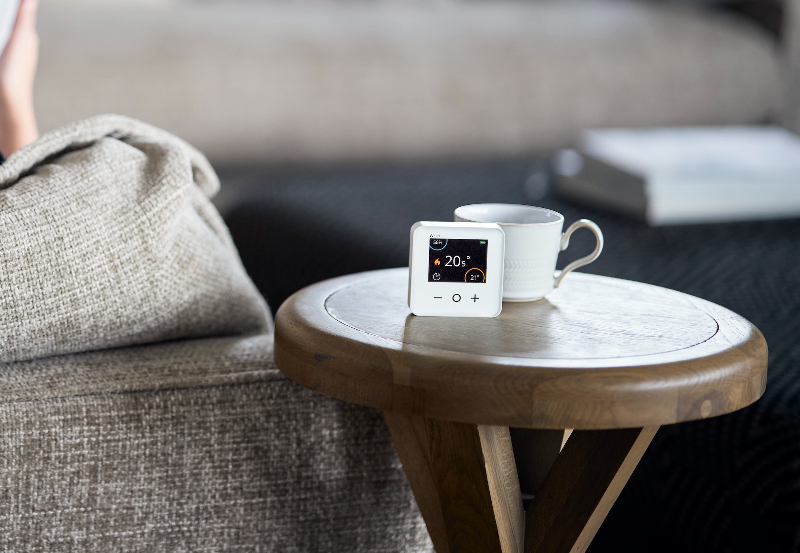
Merlin Milner, Product Owner for water-based systems at Drayton, explains how smart controls can be used to enhance performance and achieve further energy savings.
Heating engineers are increasingly being asked to deliver heating systems that are both efficient and cost-effective, while still maintaining the comfort levels that are expected by homeowners. However, now that boilers are already operating at peak performance, simply switching them out is no longer the most effective way to improve efficiency.
As a result, for many homes – especially those that already have relatively modern boilers – additional energy savings will come from how the system is controlled. For instance, smart heating controls can help installers and their customers to reduce energy use from existing heating systems without compromising on comfort.
Why upgrade?
Research from BEAMA revealed that upgrading a basic Class I room thermostat to a Class V heating control can reduce energy usage by up to 12%. BEAMA field trials also found that replacing a standard thermostat and programmer with a smart programmable thermostat reduced gas usage by around 5%, which demonstrates the impact that smart controls can have.
By optimising how and when heat is provided, smart controls ensure the boiler only operates when necessary. So, what efficiency-improving features do smart controls consist of?
Multi-zone heating
By dividing a property into zones or individual rooms, each with its own temperature control, homeowners can avoid wasting energy through heating unoccupied areas of the home.
With advanced systems like Wiser and the Wiser Home app, room-by-room heating control can be easily managed via a smartphone app which allows users to modify the temperatures of each room to suit their comfort levels and reduce wasted energy. Multi-zoning capabilities allow for simple, convenient, and highly efficient management of the homeowner’s heating system and are ideal for multi-generational households.
Through reducing wasted energy, BEAMA data shows that through multi-zoning alone in a property, can deliver up to 19% savings on energy bills.
Smart modes
Many smart controls also include intelligent operating modes that adapt to homeowners’ routines and the environment.
Smart modes, like Wiser’s Eco Mode or Away Mode for instance, contribute to enhancing a boiler’s performance which leads to further energy savings. Its Eco Mode combines optimum stop and weather compensation to learn the thermal properties of the home. Using this information, it automatically turns the boiler off earlier while still maintaining the desired temperature. Away Mode is another energy-saving feature, which enables homeowners to turn off their heating when they leave the house without having to adjust their regular schedule.
Research among Wiser users has shown that utilising these smart modes can reduce energy use by an average of 16%, without impacting the comfort of their home environment.
Valuable insights
In addition to offering intuitive control, some smart systems provide homeowners with useful insights into how they use their heating.
Taking the Wiser Home app for example, this includes an Insights feature that allows users to track internal and external temperatures, view heating patterns, and identify potential areas for optimisation. When paired with a smart meter, Insights+ provides more analysis which includes real-time energy use, spend tracking, and heating predictions.
These insights enable homeowners to make informed decisions about their energy usage to enhance the efficiency of their heating system. Research shows that using data insights when connected to a smart meter can deliver an additional 7% in savings.
Investing in efficiency
Through a combination of all the elements discussed here, a smart heating control system like Wiser can make a total saving of up to 30% on a household’s energy consumption. So, for heating engineers, recommending smart controls offers an opportunity to add value for their customers by improving system performance without the need for major, costly appliance upgrades. With boilers already operating at excellent efficiency, smart controls are the next step to leading homeowners to boosted efficiency and a reduction in wasted energy.
Additionally, recent research by Drayton revealed that 96% of its customers were interested in integrating smart home technology within their homes, suggesting demand for products such as smart controls will continue to increase.
The survey also revealed that 66% ranked a smartphone app as the most important feature when choosing a smart heating control, 50% selected multi-zoning capability, and 48% said energy saving features, such as smart modes. Therefore, as well as being important due to their efficiency-improving benefits, choosing a smart heating control that provides these features will also help fulfil customer demands.
Image: Drayton