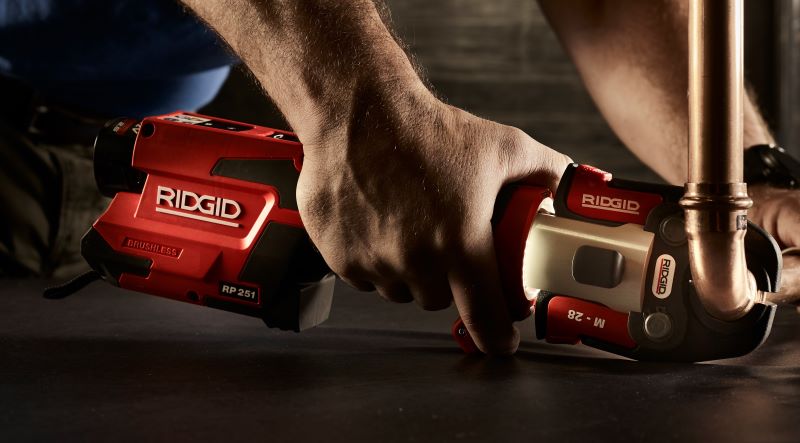
Evelynn Verdyck, Product Manager Plumbing Pressing at RIDGID, answers some of the more common questions about pressing – and explains how the RIDGID press tool range has been developed to support modern installations.
Q. Why are plumbers considering pressing fittings instead of traditional jointing methods?
Plumbers across Europe are increasingly choosing press fittings over soldering, brazing or threading because pressing is faster, cleaner and more consistent. Pressing eliminates the need for open flames, gases or extensive preparation, making it safer for use in occupied buildings and confined environments.
From a productivity standpoint, press connections can be completed in just seconds, significantly reducing installation time on-site. The result is predictable joint quality, fewer installation errors and reduced rework. For many contractors, this translates directly into lower labour costs and faster project completion.
Q. What types of fittings are required?
Press tools are designed to work with approved press fittings that match the pipe material and profile being installed. Commonly used fittings in Europe include:
– Copper press fittings (commonly used with M-profile or V-profile)
– Stainless steel press fittings (commonly used with M-profile or V-profile)
– Multi-layer and composite pipe systems (commonly used with TH-profile or U-profile)
Each system requires the correct press profile (such as M, V or other regional standards) and compatible jaws or rings. Using manufacturer-approved fittings and press profiles is essential to ensure leak-free, compliant installations.
Q. What factors should plumbers look out for when considering the type of press tool to invest in.
When choosing a press tool, plumbers should consider several key factors:
– Compatibility: The tool must support the pipe sizes, materials and press profiles commonly used in local markets.
– Size and ergonomics: Compact, lightweight tools like RP 115 and RP 251 reduce fatigue and improve access in confined spaces.
– Press force and consistency: Reliable, controlled pressing ensures joint integrity every time.
– Battery performance: Adequate runtime is critical for uninterrupted work on-site. With our 12V Platform up to 150 press cycle can be achieved on a single charge, for our 18V platform that goes even to up to 250 press cycles.
– Service and support: Availability of servicing and warranty coverage across Europe is essential for long-term investment protection. RIDGID Press Tools RP 251 and RP 350 or RP 351 offer more than 60K cycles on a tool, which means that there is no scheduled service required, reducing downtime and maintenance cost even further.
Q. Accessing tight spaces is required in many installations. How does the RIDGID Press tools help?
The RIDGID RP 115 & RP 251 are specifically designed for installations where space is limited. Their compact, in-line design allows plumbers to work closer to walls, ceilings and corners where traditional press tools may struggle.
With a slim grip circumference and optimised balance, the RP 115 & RP 251 improve manoeuvrability while maintaining the pressing performance required for professional installations. This makes it particularly suitable for renovation projects, riser cupboards and service shafts commonly found in European buildings.
Q. How is the unit powered and how many press cycles can be completed?
All RIDGID Press Tools are powered by a rechargeable lithium-ion battery, providing cordless convenience and mobility on-site. The RP 115 & RP 251 are powered with a small 12V Lithium Ion Battery. A single fully charged battery is capable of completing up to 150 of press cycles, depending on pipe size, fitting type and working conditions.
The RP 219, RP 350 & RP 351 are powered with our high performance 18V Lithium Ion Battery. A single fully charged battery is capable of completing up to 250 of press cycles, depending on pipe size, fitting type and working conditions.
This level of performance allows plumbers to work through a full day’s installations without frequent battery changes, supporting efficient workflows on both small and large projects.
Q. Does the tool require servicing and how can a plumber keep track of this information?
The value point of the RIDGID RP 251 is without a doubt the Brushless Motor, which can perform up to 60000 cycles without the need of scheduled maintenance intervals. For our RP 350 & RP 351 the brushless motor is capable to provide you up to 100,000 cycles without the need for scheduled maintenance.
RIDGID designs its press tools with built-in service indicators that alert users when maintenance is due.
Plumbers can also track tool information such as service history and serial numbers through RIDGID’s Link App, helping contractors manage fleets and remain compliant with manufacturer recommendations.
Q. What kind of a warranty isavailable?
RIDGID press tools, including the RP251, are backed by the RIDGID Lifetime Warranty.
This commitment reflects RIDGID’s focus on durability, reliability and total cost of ownership, giving European plumbers confidence that their investment is protected well beyond the initial purchase.
Image: Ridgid