
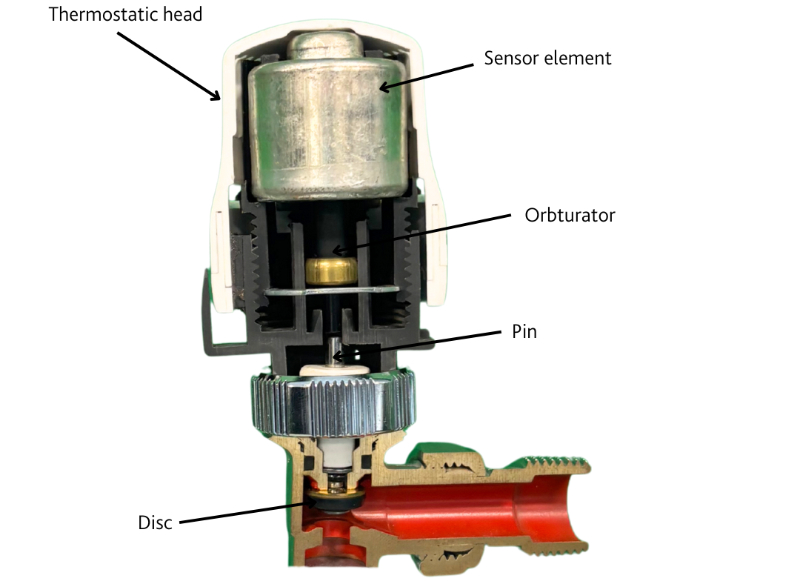
Ed Morris, Technical Manager at Altecnic, takes a look inside a TRV to see how it works.
Thermostatic Radiator Valves (TRVs) are one of the simplest ways to give heating systems automatic temperature control, offering both user comfort and energy saving.
What does a TRV do?
A TRV automatically adjusts the flow of hot water into a radiator based on the temperature in the room. As the temperature changes, the valve opens or closes to maintain a set level of warmth. This means radiators don’t constantly run at full heat, helping to keep rooms comfortable and avoid wasted energy.
It also provides frost protection, the Ecocal™ TRV, for example, has a setting that keeps the temperature at around 7 °C to prevent pipes freezing in cold weather.
How it works
The TRV is made up of two main parts: the thermostatic head (which senses the room temperature) and the valve body (which controls the flow of hot water). These parts work together automatically.
Thermostatic Head: Internal Mechanisms
Sensor Element
At the top of the valve is the thermostatic head. Inside it is a sensor element filled with a special liquid or wax.
– When the room warms up, the liquid expands
– This pushes down on a small pin, gradually closing the valve
– When the room cools, the liquid contracts and the pin moves back up, allowing the valve to open again
This simple expansion and contraction process means the valve is constantly adjusting itself to maintain the chosen temperature.
Obturator & Pin
Between the sensor and the valve body sits the obturator, a small component that transfers the sensor’s movement into a smooth, controlled push on the pin.
The pin is the part that physically moves in and out of the valve body. When pushed down, it restricts the flow of water. When released, a spring pushes it back up, opening the valve.
This mechanism ensures accurate, smooth operation without sticking or sudden changes.
Valve Body: Internal Mechanisms
Hot water from the heating system enters one side of the valve and flows through to the radiator. The path travelled by the water is controlled by a disc connected to a spindle and spring.
– When the pin is pushed down (room warming up), it presses the spindle and disc towards the valve seat, reducing flow into the radiator
– When the room cools, the spring pushes the disc back, opening the valve and letting more hot water through
This setup allows the TRV to modulate flow, not just switch on or off, giving steady temperature control.
Customer comfort
For installers, TRVs provide a straightforward and reliable way to boost both system performance and customer comfort. By automatically regulating radiator output based on room temperature, they ensure each space maintains the right level of warmth without constant manual adjustment. This not only improves the overall efficiency of the heating system but also helps homeowners reduce energy bills and avoid overheating rooms unnecessarily.
Image: Altecnic