
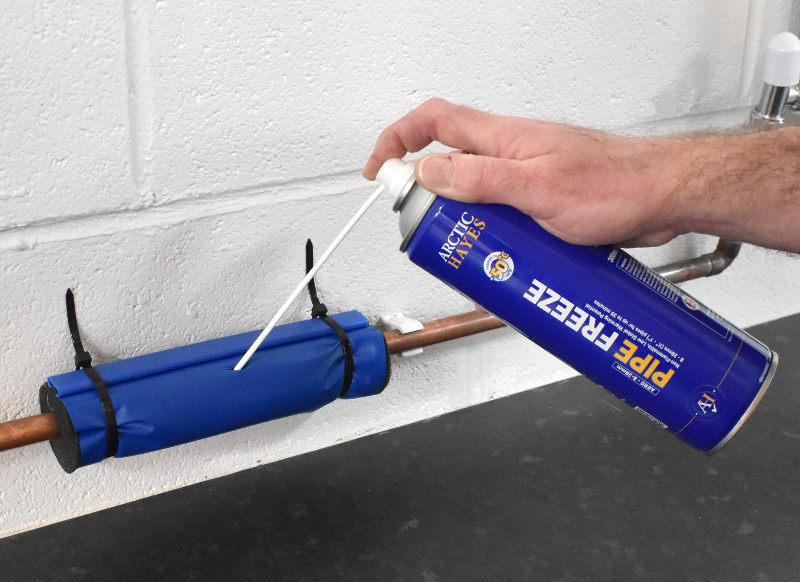
Lee Parsons, MD at Arctic Hayes, discusses how pipe freezing can help heating engineers save time, reduce disruption and maintain control.
Time on site isn’t what it used to be. Call-out windows have tightened, customer expectations have risen and the UK’s mix of ageing, complex and heavily modified heating systems means even simple jobs can become unpredictable.
Installers are looking for ways to protect their time and avoid the spirals of disruption that come with draining and refilling systems. One shift that has taken hold over the past few years is the move towards pipe freezing as a fast, clean and dependable way to isolate pipework without emptying an entire circuit.
What was once seen as a specialist intervention has now become part of everyday practice. Many installers are discovering that by avoiding a full drain-down, they remove a significant amount of uncertainty from the job.
Avoid draining down
For South Wales heating engineer Paul Williams, who has spent more than three decades on the tools, freezing has become the default method whenever the work allows. As he puts it, “If you can avoid draining down, you eliminate hours of wasted time and potential new problems. Pipe freeze gives you that control – it’s clean, reliable and keeps the job moving.”
Paul first encountered pipe freezing at a CIPHE South Wales training session. The demonstration showed him how a well-executed freeze holds firm, even on older systems, and how much disruption could be avoided by isolating only the section that actually needs attention. From there it quickly moved from an occasional tactic to a routine part of his workflow. He now uses freezing for radiator moves, valve replacements and localised heating issues where disturbing the wider system risks triggering air locks, shifting debris or opening the door to faults he didn’t create.
The benefits are felt most on the sort of real-world jobs that installers face every day. In one recent property, Paul needed to move a radiator positioned on a difficult heating circuit. Draining the system would have introduced a host of variables, from slow drain points to air locks on refill. Freezing the pipe gave him a clean, contained window to do the work. As he explains, “If I’d drained the system, I’d have been there another two or three hours fixing air locks and refilling. Instead, it was done in no time with no leaks and no mess.”
Heating and plumbing professionals in similar situations often highlight the same considerations. Draining a system is rarely just a functional step; it introduces risk, adds labour time and, in many homes, creates unnecessary disruption for the customer. Freezing avoids those pitfalls entirely, and that is especially important in properties with vulnerable residents.
Paul regularly works in homes where elderly customers rely on their heating and shutting it down for even a short period can cause distress or discomfort. Being able to isolate a single section allows him to complete the work without cooling the entire property. As he puts it, “It’s brilliant for elderly customers. You can work on a section without leaving them in the cold. On complex systems, it means you’re not inheriting someone else’s problems by draining everything down.”
There is also a broader efficiency trend driving the shift. The heating sector is under pressure to deliver more in the same amount of time. Installers are juggling heavier workloads, while retrofit work and upgrades continue to rise. Pipe freezing enables a more controlled, more predictable process.
Stay in control
The growing adoption of pipe freezing reflects a wider mindset shift across the industry. Installers want methods that keep them in control, minimise downtime and reduce reliance on processes that create mess, delay or uncertainty. Freezing simplifies the job – it removes the guesswork that comes with full drain-downs and allows installers to focus on the task at hand rather than the complications surrounding it.
As the sector continues to balance high workloads with rising customer expectations, solutions that save time and preserve system stability will play a larger role in everyday practice. For installers like Paul, freezing has already become that solution – a practical, proven way to work more cleanly, more efficiently and more confidently on site. It’s a small process change with a big impact, and one that many now consider an essential part of keeping jobs moving and customers satisfied.
Image: Arctic Hayes