
Michael Pitt, UK Technical Advisor at Spirotech, explores the importance of pressure maintenance and what heating engineers must account for when selecting the correct solution.
When it comes to pressure maintenance, there are a number of calculations that heating engineers must make to correctly design the system. As well as determining between suction side and discharge side, along with fixed gas vs pumped systems, engineers must account for pressure, volume, and temperature when specifying a vessel.
Pressure
There are two main types of pressure, which are influenced by several components. The static pressure is mainly determined by the height of the system. The dynamic pressure is influenced by components such as the pump valves, piping, the heat source – for example a boiler – and users. Together, these define the system’s pressure profile, which the expansion vessel must stabilise.
EN 12828 outlines certain limits. At the lower end is P₀, the minimum system pressure, equal to the static head plus 0.2 bar and a margin against evaporation. Above this sits the initial pressure (cold fill), typically 0.5 bar above static height.
At the upper end is the maximum allowable system pressure, which must always stay below the safety valve setting. EN 12828 requires a buffer of at least 0.5 bar or 10%, whichever is greater.
Between these lies the working range, in which the system must operate across all conditions. Below the minimum pressure, the system risks issues like air ingress or partially operation, meanwhile above the maximum pressure, it risks opening the safety valve.
Volume
For correct selection, a number of volumes are needed, some of which must be calculated from system values. The total water content is required, and along with knowing the temperatures or density, we get the thermal expansion volume. On top of this value, a water reserve should be added for top ups and bleeding. Together these define the minimum usable vessel volume, which leads to the nominal vessel size.
Temperature
Finally, the expected temperature range must be accounted for. This covers the lowest system temperature – often the cold fill, return temperature – the maximum operating temperature, and the safety limit to set temperature. These values give the expansion coefficient E, which in turn gives the expansion volume we must provide.
Engineers will also need the total system volume and the fluid medium, these are used to calculate the expanding volume and the required vessel size.
Fixed Gas vs Pumped Spill Systems
Once design values are known, engineers select a pressure maintenance method, of which EN 12828 recognises two main approaches.
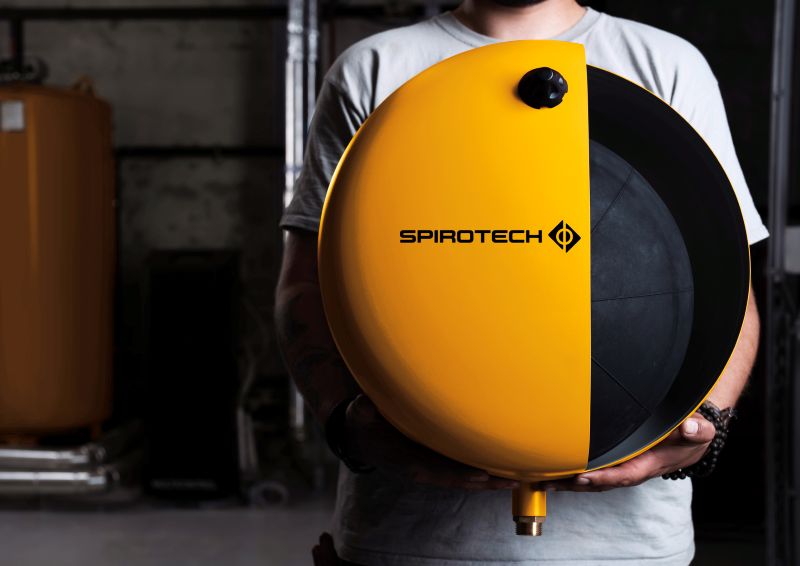
Fixed gas vessels are traditional steel tanks with a diaphragm or bladder separating gas and water. Water expansion compresses the gas, stabilising pressure. Usable volume is only 30–50% of total, so large vessels are needed.
Meanwhile, in a pumped spill system, the pressure in the vessel is atmospheric or pressureless, so almost the full volume is usable as it doesn’t need to compress any gas. It also allows for smaller units to be used, ideal for tall buildings or district heating.
Importance of correct selection
Incorrect selection or poor positioning can drop suction pressure below atmospheric causing air to be drawn in to the system. Air ingress harms water quality and leads to corrosion, which reduces efficiency, increases maintenance costs and increases energy consumption.
For heating engineers, the process is simple; start with accurate pressure, volume, and temperature values, then choose the technology suited to the building, space, and maintenance strategy. Tools such as Spirotech’s product selector can simplify this by recommending the most suitable product based on system inputs.
Image: Spirotech